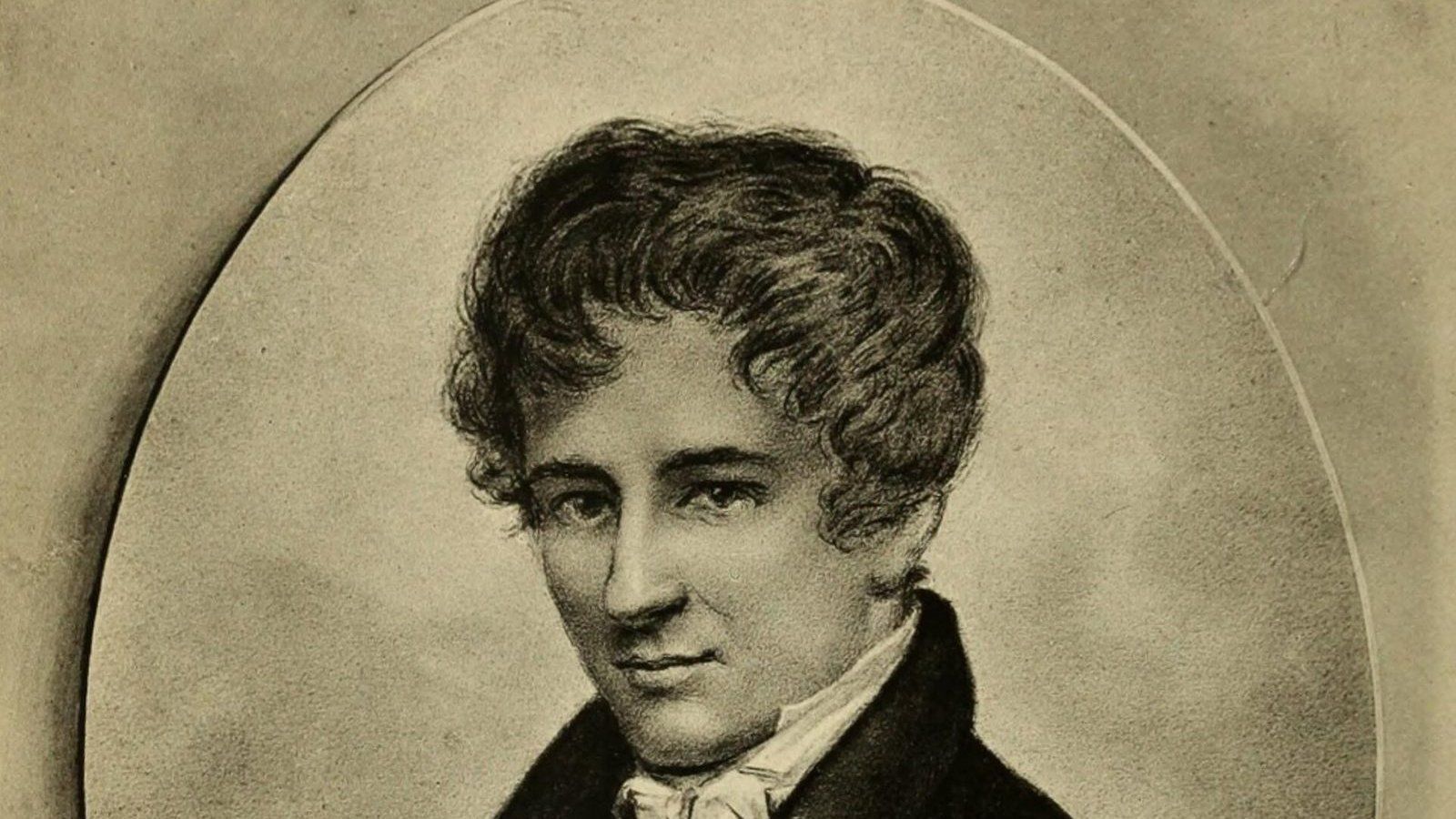
 Image: Johan Gørbitz (public domain)
Why there is no formula for the quintic
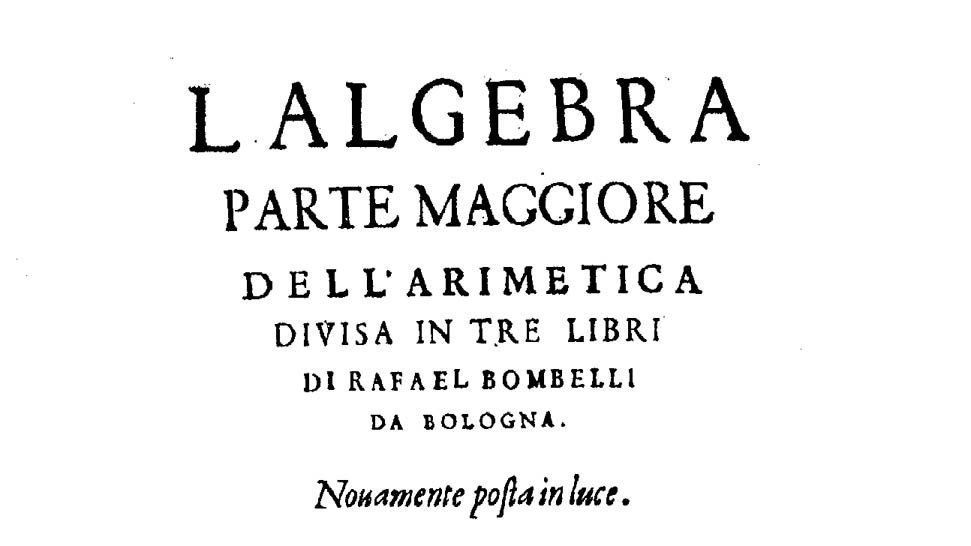
The quadratic formula is learned at school. The cubic formula, found in Bologna around 1515 and printed in 1545, and the quartic formula, found by Ferrari soon after, are longer and rarely taught, but they exist, and they do the same job: starting from the coefficients, they reach the roots using addition, subtraction, multiplication, division, and the extraction of roots. For the equation of degree 5 the search for such a formula went on for nearly three centuries. In 1824 a 21-year-old Norwegian proved that it does not exist. The portrait at the top is the only one made of him during his life.
What is being claimed
The claim has to be stated carefully, because every quintic equation has five roots, by the fundamental theorem of algebra, and they can be computed to any number of decimal places by Newton's method or any other numerical scheme. What does not exist is a formula in radicals: an expression built from the coefficients \(a, b, c, d, e\) of \(x^5 + ax^4 + bx^3 + cx^2 + dx + e\) using the four arithmetic operations and \(n\)-th roots, nested as deeply as you like, that gives a root for every choice of coefficients. For degree 4 such an expression exists and fills about a page. For degree 5 there is none, and the obstruction is not that nobody has been clever enough.
Some quintics are solvable by radicals. The equation \(x^5 = 2\) has the root \(\sqrt[5]{2}\). The equation \(x^5 - 5x + 12 = 0\) has roots that can be written with square roots and fifth roots, though the expression is unpleasant. The theorem says that no single formula works for all quintics, and the stronger theorem that Galois proved says exactly which quintics have radical expressions for their roots and which do not. The standard witness for "do not" is
\[ x^5 - 6x + 3 = 0, \]whose five roots cannot be written in radicals, in any way, however long.
Three people and 32 years
Paolo Ruffini, a physician and mathematician in Modena, published a proof of the impossibility in 1799, in a two-volume book that almost nobody read and that Lagrange, to whom he sent it, never answered. His argument had a gap: he assumed without proof that any radicals appearing in a hypothetical formula could be taken to be expressions in the roots themselves. The assumption is true, but it needs proving, and the proof is the hard part. Ruffini's proof is described today as incomplete rather than wrong, and he deserves the half of the theorem's name that he has.
Niels Henrik Abel (1802-1829), a student in Christiania, now Oslo, believed for a few months in 1821 that he had found the formula, discovered his error when asked for a numerical example, and turned to proving that no formula could exist. He printed his proof in 1824 as a six-page pamphlet in French, at his own expense, compressing it so much to save money that it was barely readable, and published a fuller version in 1826 in the first volume of Crelle's new journal in Berlin. He closed Ruffini's gap. He was then 23, and he died of tuberculosis in April 1829, two days before a letter arrived offering him a professorship in Berlin.
Évariste Galois, as the previous article told, found the reason behind the theorem: a criterion that decides, for any given equation, whether its roots can be written in radicals. His memoir of 1831 was rejected, and the criterion was published by Liouville in 1846, fourteen years after his death.
The idea of the proof
Here is Galois's argument in outline, in the language of Units 14 and 15. To a polynomial attach its Galois group: the rearrangements of its roots that respect every algebraic relation among them. For the general quintic, where the coefficients are independent symbols, there are no relations among the roots beyond the ones forced by the coefficients, and the group is all 120 rearrangements of five objects, the symmetric group \(S_5\). For \(x^5 - 6x + 3\) the group is again \(S_5\), for reasons given below.
Now suppose the roots could be written in radicals. Build the formula from the inside out: first adjoin a square root, say, then a cube root of something involving it, and so on, until the roots are reached. Galois showed that each adjunction of an \(n\)-th root, when \(n\) is prime and the necessary roots of unity are present, shrinks the group to a normal subgroup of prime index, a subgroup of the kind that the tiling article described, with the number of tiles a prime. If the roots are eventually reached, the group has shrunk to the trivial group. So a polynomial solvable by radicals has a Galois group that can be reduced to the identity through a chain of normal subgroups with prime indices. Such groups are called solvable, and the name comes from exactly this theorem.
The last step is to check that \(S_5\) is not solvable. It has a normal subgroup of index 2, the alternating group \(A_5\) of 60 even rearrangements, and that is where the chain stops: \(A_5\) has no normal subgroups at all apart from itself and the identity. A group with that property is called simple, and \(A_5\) is the smallest non-abelian simple group. Proving its simplicity is a counting argument of a page, done in Unit 9: the 60 elements fall into five conjugacy classes of sizes 1, 15, 20, 12, and 12, a normal subgroup is a union of such classes containing the class of size 1, and its order must divide 60 by Lagrange's theorem, and no sum of class sizes that includes 1 gives a proper divisor of 60. So the chain for \(S_5\) breaks after one step, \(S_5\) is not solvable, and no formula in radicals can exist for the general quintic or for any particular quintic whose group is \(S_5\).
For degrees 2, 3, and 4 the corresponding groups \(S_2\), \(S_3\), and \(S_4\) are solvable, which is why the formulas exist. The chain for \(S_4\) is \(S_4 \supset A_4 \supset V_4 \supset C_2 \supset \{e\}\), with indices 2, 3, 2, 2, and the three square roots and one cube root in Ferrari's formula correspond to those four steps. The theory does more than forbid; it predicts the shape of the formulas that do exist.
Why \(x^5 - 6x + 3\)
Three facts about this polynomial give it the group \(S_5\), and they are the kind of facts Units 12 and 15 teach a reader to check. It is irreducible over the rationals by Eisenstein's criterion with the prime 3, since 3 divides \(-6\) and \(3\) but \(9\) does not divide 3. Irreducibility of degree 5 forces the group to contain an element of order 5, a 5-cycle. It has exactly three real roots, which one sees by evaluating at \(-2, -1, 0, 1, 2\) and finding three changes of sign, so the two remaining roots are complex conjugates, and complex conjugation acts on the roots as a transposition, swapping those two and fixing the rest. A subgroup of \(S_5\) that contains a 5-cycle and a transposition is all of \(S_5\), a short calculation with permutations. So the group is \(S_5\), not solvable, and the roots, three of which you can see on a graph, cannot be reached by any formula.
What came after
The theorem did not end the study of the quintic. Charles Hermite showed in 1858 that the roots of any quintic can be expressed by elliptic modular functions, which are to the fifth degree what the trigonometric functions of Viète are to the casus irreducibilis of the cubic: a formula, with functions that are not radicals. Felix Klein's book of 1884 on the icosahedron connected the quintic to the rotation group of that solid, which is \(A_5\) in disguise. And the question of which groups occur as Galois groups of polynomials over the rationals, the inverse Galois problem, is open today and is the subject of Unit 16.
Unit 8 states the Abel-Ruffini theorem and computes the Galois group of three small polynomials by hand; Unit 15 proves the theorem as sketched above. The MacTutor biography of Abel tells the rest of a short life, including the trip to Paris in 1826 during which Cauchy lost his other great memoir. The curriculum lists the units in order.