

Complex Numbers
Why the square root of a negative number was forced on mathematicians, what complex numbers are and why the laws of arithmetic hold for them, the complex plane, polar form, de Moivre's formula and the roots of unity, the fundamental theorem of algebra with the idea of its proof, and a closing look at iteration, the Mandelbrot set, and Newton's method in the plane.
In 1572 an engineer from Bologna published a calculation that should not have worked. He applied Cardano’s formula to a cubic equation whose answer he already knew, found that the formula asked him for the square root of a negative number, carried on as if such a number existed, and arrived at the right answer. It took two more centuries before anyone could say what he had been computing with. This unit builds the numbers he needed, shows that they obey every law of arithmetic, draws them, and uses them to finish what Unit 2 started, the proof that every polynomial equation has a complete set of solutions. It ends with a picture of where those solutions lie.
1 Cardano’s formula meets a negative square root
Unit 2 derived Cardano’s formula for the depressed cubic. For an equation of the form \(x^3 + px + q = 0\) with real coefficients \(p\) and \(q\), one solution is \begin{gather} x = u + v, \qquad D = \left(\tfrac{q}{2}\right)^{2} + \left(\tfrac{p}{3}\right)^{3} , \notag \\ u = \sqrt[3]{-\tfrac{q}{2} + \sqrt{D}}, \notag \\ v = \sqrt[3]{-\tfrac{q}{2} - \sqrt{D}} , \label{eq:cardano} \end{gather} where the two cube roots \(u\) and \(v\) are chosen so that \(3uv = -p\). The formula handled \(x^3 + 6x = 20\) without trouble, because with \(p = 6\) and \(q = -20\) the expression under the square root, \((-10)^2 + 2^3 = 100 + 8 = 108\), is positive. Rafael Bombelli (1526-1572) tried it on an equation of the same shape whose answer can be guessed.
Bombelli called the new quantities “più di meno” (plus of minus) and “meno di meno” (minus of minus), wrote down the rules for multiplying them, and used them in his Algebra of 1572 (Figure 1) because they worked, while admitting that the whole thing seemed to rest on sophistry, that is, on reasoning that looks clever but is not sound. The calculation raises two questions: what kind of object \(\sqrt{-1}\) is, and why the ordinary rules of algebra should apply to it. The next section answers both.

2 The complex numbers
2.1 Pairs of real numbers
The honest way to introduce a new number is to say exactly what it is and how it is added and multiplied, and then to check the laws. A complex number is a pair \((a, b)\) of real numbers, and the pairs are added and multiplied as follows.
The rule for the product looks arbitrary until the pair \((a, b)\) is written as \(a + bi\), which is allowed because \((b, 0)(0, 1) = (0, b)\) by the product rule, so that \((a, b) = (a, 0) + (b, 0)(0, 1)\). Then the rule is what expanding \((a + bi)(c + di)\) by the distributive law gives when \(i^2\) is replaced by \(-1\): \begin{align*} (a + bi)(c + di) &= ac + (ad + bc)\,i + bd\,i^2 \\ &= (ac - bd) + (ad + bc)\,i . \end{align*} From now on every complex number is written as \(z = a + bi\). The number \(a\) is the real part \(\Re z\) and the number \(b\) the imaginary part \(\Im z\); both are real numbers. Two complex numbers are equal exactly when both parts agree. The word “imaginary” is a historical accident. A pair of real numbers is no more imaginary than a point on a map. The symbol \(i\) is a particular pair, and \(i^2 = -1\) is a consequence of the multiplication rule, which is why Bombelli’s computations were right.
The laws of arithmetic that Unit 1 listed for the real numbers (the commutative and associative laws of addition and multiplication, the distributive law, the roles of \(0\) and \(1\), and the existence of additive and multiplicative inverses) all hold in \(\mathbb{C}\). Most of them follow at once from the corresponding laws for real numbers, because each component of a sum or product is a real expression in the components; for example, the commutative law of multiplication holds because \(ac - bd = ca - db\) and \(ad + bc = cb + da\). The associative law of multiplication is a longer but equally routine check, which the reader is invited to carry out once for \((1 + i)(2 - i)\) and \(i\) in both bracketings. The zero is \(0 + 0i\), the one is \(1 + 0i\), and the additive inverse of \(a + bi\) is \(-a - bi\). Only the multiplicative inverse needs an idea, and it comes from the conjugate below.
The powers of \(i\) repeat with period \(4\), since \(i^1 = i\), \(i^2 = -1\), \(i^3 = -i\), \(i^4 = 1\), and then the cycle \(1, i, -1, -i\) starts again. Any power \(i^n\) is therefore found from the remainder of \(n\) on division by \(4\). For example, \(i^{2026} = i^{2} = -1\), because \(2026 = 4 \cdot 506 + 2\).
2.2 The complex plane, the conjugate, and the modulus
A pair of real numbers is a point in the plane, and this is the picture that made complex numbers respectable. The number \(z = a + bi\) is drawn as the point with coordinates \((a, b)\), or as the arrow from the origin to that point (Figure 2). The horizontal axis carries the real numbers and is called the real axis, and the vertical axis carries the multiples of \(i\) and is called the imaginary axis. Addition of complex numbers is addition of arrows, head to tail, as for vectors.
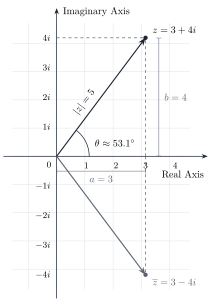
Three quantities belong to every complex number \(z = a + bi\). The conjugate \(\overline{z} = a - bi\) is the mirror image of \(z\) in the real axis; the name goes back to Augustin-Louis Cauchy (1789-1857), who introduced it in 1821. The modulus \(|z| = \sqrt{a^2 + b^2}\) is the length of the arrow, a non-negative real number, and for a real number it is the ordinary absolute value. The argument \(\arg z\) is the angle between the positive real axis and the arrow, measured anticlockwise; Section 3 uses it. The conjugate and the modulus are tied together by one identity that does most of the work in this subject: \begin{align*} z\overline{z} = (a + bi)(a - bi) &= a^2 - abi + abi - b^2 i^2 \\ &= a^2 + b^2 = |z|^2 . \end{align*} This is why multiplying by \(1 + 2i\) cleared the denominator in the last example.
The two rules for the conjugate of a sum and of a product say that conjugation can be done before or after the arithmetic, and they are checked by expanding both sides. For the product, with \(z = a + bi\) and \(w = c + di\), the left side is \((ac - bd) - (ad + bc)i\) and the right side is \((a - bi)(c - di) = (ac - bd) - (ad + bc)i\) as well. Applied repeatedly, the product rule gives \(\overline{z^n} = \overline{z}^{\,n}\) for every positive integer \(n\), a fact that Section 5 turns into a statement about the roots of real polynomials.
3 Polar form and de Moivre’s formula
3.1 Multiplication as rotation and stretching
An arrow in the plane is fixed by its length and its direction as well as by its two coordinates. If \(z = a + bi\) has modulus \(r = |z|\) and argument \(\theta\), then \(a = r\cos\theta\) and \(b = r\sin\theta\), because \(\cos\theta\) and \(\sin\theta\) are by definition the coordinates of the point at angle \(\theta\) on the circle of radius \(1\), and the arrow of \(z\) is that point stretched by \(r\) (Figure 2). Hence \begin{equation} z = r(\cos\theta + i\sin\theta) . \label{eq:polar} \end{equation} This is the polar form of \(z\). The argument is determined only up to whole turns, which means that two angles differing by a whole number of turns describe the same arrow, since adding \(2\pi\) (or \(360^\circ\)) to \(\theta\) does not move it; when one value is needed, the one in the interval \((-\pi, \pi]\) is taken. The number \(0\) has modulus \(0\) and no argument.
In polar form, multiplication becomes geometry. To multiply two complex numbers, multiply their moduli and add their arguments.
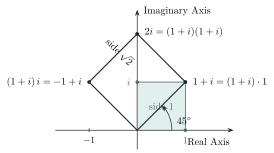
Two special cases show what the rule means. The number \(i\) has modulus \(1\) and argument \(90^\circ\), so multiplying by \(i\) turns every arrow through a right angle anticlockwise and changes no length, and multiplying by \(i\) twice turns the plane through half a turn, which is multiplication by \(-1\). This is the geometric meaning of \(i^2 = -1\). The number \(1 + i\) has modulus \(\sqrt{2}\) and argument \(45^\circ\), so multiplication by \(1 + i\) turns the plane through \(45^\circ\) and stretches it by \(\sqrt{2}\). Figure 3 shows what this does to the square with corners \(0\), \(1\), \(1 + i\), and \(i\). Unit 4 describes the same turn and stretch by a \(2 \times 2\) matrix, which gives a second way of building \(\mathbb{C}\).
3.2 De Moivre’s formula and Euler’s formula
When a number of modulus \(1\) is multiplied by itself over and over again, the multiplication rule adds the same angle at every step and leaves the modulus at \(1\), so all the powers of such a number can be written down at once. The result is named after Abraham de Moivre (1667-1754), who used it from 1707 onwards.
The expression \(\cos\theta + i\sin\theta\) appears so often that it deserves a shorter name, and the name mathematics settled on is an exponential. Multiplication adds the arguments, exactly as multiplication of powers adds the exponents, and this is the reason for the notation.
An expert will object that \(e^{i\theta}\) ought to be the exponential function \(e^{x}\) continued to complex arguments, and that the formula should then be a theorem. That is correct, and the proof compares the power series of the exponential, the sine, and the cosine, which needs calculus and lies beyond this unit. Everything this program uses is the definition together with the five properties just listed, and in those terms \(re^{i\theta}\) is the polar form written compactly. The unit uses both notations from here on.
4 Roots of unity and the cubic completed
4.1 The \(n\)-th roots of unity
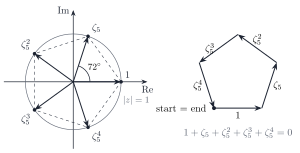
The equation \(z^2 = 1\) has the two solutions \(1\) and \(-1\). How many solutions does \(z^n = 1\) have in \(\mathbb{C}\), and where are they? De Moivre’s formula answers both questions. If \(z = re^{i\theta}\), then \(z^n = r^{n}e^{in\theta}\). This equals \(1\) exactly when two things hold at once: the modulus \(r^{n}\) is \(1\), which for a positive real number \(r\) means \(r = 1\), and the angle \(n\theta\) is a whole number of turns, which means \(\theta = 2\pi k/n\) for some integer \(k\). The values \(k = 0, 1, \ldots, n - 1\) give \(n\) different arrows, and \(k = n\) gives the same arrow as \(k = 0\) again.
The number \(\zeta_n\) is called a primitive \(n\)-th root of unity, because all the others are its powers. Multiplying two \(n\)-th roots of unity gives a third, because the arguments add and a sum of two multiples of \(2\pi/n\) is again a multiple of \(2\pi/n\), and Unit 5 returns to these \(n\) points as one of its first examples of a group. The claim about the sum has a two-line proof. Let \(S = 1 + \zeta_n + \zeta_n^{2} + \cdots + \zeta_n^{n-1}\). Multiplying \(S\) by \(\zeta_n\) turns each term into the next one, \(\zeta_n S = \zeta_n + \zeta_n^{2} + \cdots + \zeta_n^{n-1} + \zeta_n^{n}\), and the new last term \(\zeta_n^{n} = 1\) is the first term of \(S\). The two sums therefore contain the same \(n\) terms, so \(\zeta_n S = S\), which gives \((\zeta_n - 1)S = 0\). For \(n \ge 2\) the factor \(\zeta_n - 1\) is not zero, and therefore \(S = 0\). Figure 4 shows the geometric version of the same statement: the five arrows of the fifth roots of unity, placed head to tail, close up into a regular pentagon and return to their starting point.
The cube roots of unity appear in the cubic formula and are used again in Unit 8, so they get their own symbol. With \(\omega = \zeta_3 = e^{2\pi i/3}\), Table 1 lists the three roots of \(z^3 = 1\) in both forms. The identity \(1 + \omega + \omega^2 = 0\) is the case \(n = 3\) of the sum rule, and \(\overline{\omega} = \omega^2\) follows from the table.
| Root | Rectangular Form | Polar Form |
|---|---|---|
| \(1\) | \(1\) | \(e^{0}\) |
| \(\omega\) | \(-\tfrac{1}{2} + \tfrac{\sqrt{3}}{2}\,i\) | \(e^{2\pi i/3}\) |
| \(\omega^{2}\) | \(-\tfrac{1}{2} - \tfrac{\sqrt{3}}{2}\,i\) | \(e^{4\pi i/3}\) |
4.2 The \(n\)-th roots of any complex number
The same method finds the \(n\)-th roots of any non-zero complex number \(w = \rho e^{i\alpha}\), where the Greek letter \(\rho\) (rho) stands for the modulus of \(w\). The equation \(z^{n} = w\) with \(z = re^{i\theta}\) requires \(r^{n} = \rho\) and \(n\theta = \alpha + 2\pi k\), so the solutions are \begin{equation} z_k = \rho^{1/n}\,e^{i(\alpha + 2\pi k)/n}, \qquad k = 0, 1, \ldots, n - 1 . \label{eq:nthroots} \end{equation} Here \(\rho^{1/n}\) is the ordinary positive \(n\)-th root of the positive number \(\rho\). Every non-zero complex number therefore has exactly \(n\) different \(n\)-th roots, spaced evenly on the circle of radius \(\rho^{1/n}\); each of them is the first one, \(z_0\), multiplied by a power of \(\zeta_n\), because multiplying by \(\zeta_n\) adds \(2\pi/n\) to the argument and leaves the modulus unchanged.
4.3 Cardano’s formula completed
Section 1 left two questions open. A complex number has three cube roots, so Cardano’s formula offers more than one value, and the equation \(x^3 = 15x + 4\) has two further roots that the formula seemed not to produce. By Equation \eqref{eq:nthroots}, the cube roots of \(2 + 11i\) are the first one multiplied by the powers of \(\omega\), namely \(2 + i\), \(\omega(2 + i)\), and \(\omega^2(2 + i)\), and in the same way the cube roots of \(2 - 11i\) are \(2 - i\), \(\omega(2 - i)\), and \(\omega^2(2 - i)\). The rule \(3uv = -p = 15\), that is \(uv = 5\), decides which pairs belong together. Since \(\omega\cdot\omega^2 = 1\), the product \(\omega(2 + i)\cdot\omega^2(2 - i)\) is \((2 + i)(2 - i) = 5\), whereas \(\omega(2 + i)\cdot\omega(2 - i)\) would be \(5\omega^2\), so the pairs are \((2 + i, 2 - i)\), \((\omega(2 + i), \omega^2(2 - i))\), and \((\omega^2(2 + i), \omega(2 - i))\). The three sums \(u + v\) are the three roots of the cubic. The first sum is \(4\). For the second, \(\omega(2 + i) = \tfrac{1}{2}(-1 + \sqrt{3}\,i)(2 + i)\), which multiplies out to \(\tfrac{1}{2}\bigl((-2 - \sqrt{3}) + (2\sqrt{3} - 1)i\bigr)\), and its partner \(\omega^2(2 - i)\) is its conjugate, because \(\omega^2 = \overline{\omega}\) and conjugation respects products, so the sum is twice the real part, \(-2 - \sqrt{3}\). The third pair gives \(-2 + \sqrt{3}\) in the same way. All three roots of \(x^3 = 15x + 4\) come out of the formula, and all three are real, although every one of them was computed through \(\sqrt{-121}\).
The example is typical. Whenever a cubic with real coefficients has three different real roots, the quantity under the square root in Cardano’s formula is negative, and the formula cannot avoid complex numbers; this situation is called the casus irreducibilis, Latin for the irreducible case. A theorem proved by Pierre Wantzel (1814-1848) in 1843, whose proof lies beyond this unit, says that when such a cubic has rational coefficients and no rational root, none of its roots can be written with real radicals alone, that is, with square roots, cube roots, and higher roots of real numbers, so no cleverer formula avoids the detour through \(\mathbb{C}\). Bombelli’s equation escapes the theorem only through its rational root \(4\). The real numbers are not enough to solve real cubics, which is the strongest argument for \(\mathbb{C}\) that the sixteenth century could have had.
5 The fundamental theorem of algebra
5.1 Every polynomial has a root
Unit 2 proved that a polynomial of degree \(n\) has at most \(n\) roots and promised that over \(\mathbb{C}\) the count is exact.
The second sentence follows from the first by the factor theorem of Unit 2, whose proof used only division with remainder and therefore works for complex coefficients as well. If \(r_1\) is a root of \(f\), then \(f(x) = (x - r_1)g(x)\) with \(\deg g = n - 1\); if \(n - 1 \ge 1\), the theorem gives a root \(r_2\) of \(g\), and so on, until a constant is left, which must be the leading coefficient \(a_n\).
Jean le Rond d’Alembert (1717-1783) published the first serious attempt at a proof in 1746, which contained gaps: among them, he assumed that the modulus \(|f(z)|\) attains a smallest value somewhere, a fact that is true but was not proved until the following century. Gauss gave a proof in his doctoral dissertation of 1799 and criticized all earlier attempts; by modern standards his first proof has a gap as well. The shortest of the classical proofs, published by Argand in 1814, repairs d’Alembert’s idea; it too takes the smallest value for granted, and that step was secured only by the analysis of the 1870s. Every proof uses more than algebra, because the theorem depends on a property of the real numbers that algebra alone does not see, namely that they have no gaps.
A full proof is beyond this unit, but the idea of one proof can be seen in a picture. Consider the polynomial \(f(z) = z^{n} + (\text{terms of lower degree})\), and watch where \(f\) sends a circle \(|z| = R\) as the point \(z\) runs around it once. For a very large \(R\) the leading term dominates, and \(z^{n}\) runs \(n\) times around the origin, because its argument is \(n\) times the argument of \(z\); the lower terms disturb this curve a little but cannot pull it across the origin, because for large \(R\) their combined size is far smaller than \(R^{n}\), so the image curve still winds \(n\) times around \(0\). For a very small \(R\) the image stays close to the constant \(f(0)\) and, if \(f(0) \neq 0\), does not wind around \(0\) at all. As \(R\) shrinks from very large to very small, the image curve changes continuously, and the number of times it winds around \(0\) can only change when the curve passes through \(0\). Somewhere on the way, therefore, some \(z\) has \(f(z) = 0\). Making the words “continuously” and “winds around” precise belongs to analysis and lies beyond this program.
5.2 Consequences for real polynomials
Most polynomials that arise in practice have real coefficients, and for them the theorem says something about the shape of the complex roots.
The quadratic formula shows the pairs explicitly. By completing the square (Unit 1), the roots of \(x^2 + bx + c\) with real \(b\) and \(c\) are \(-b/2 \pm \sqrt{b^2/4 - c}\), and when \(b^2/4 - c\) is negative, the square root of the negative number \(-(c - b^2/4)\) is \(i\sqrt{c - b^2/4}\). The two roots are then \[ x = -\frac{b}{2} \pm i\sqrt{c - \frac{b^2}{4}} , \] a conjugate pair with real part \(-b/2\). For example, \(x^2 - 2x + 2\) has the roots \(1 \pm i\), and indeed \((x - 1 - i)(x - 1 + i) = (x - 1)^2 + 1 = x^2 - 2x + 2\).
Where do the roots of polynomials lie? Figure 5 answers the question for one family, all monic polynomials \(x^4 + ax^3 + bx^2 + cx + d\) whose four coefficients are integers between \(-2\) and \(2\); there are \(5^4 = 625\) of them, one for each choice of the four coefficients from five values. Their \(4 \cdot 625 = 2500\) roots, counted with multiplicity, fall on \(1725\) different points, and only \(571\) of those lie on the real axis. Three features of the picture are theorems. The cloud is symmetric about the real axis by the conjugate pair rule. No root lies farther than \(3\) from the origin. For \(|z| > 3\) the factor \(|z| - 1\) is larger than \(2\), so the identity \(|z|^4 - 1 = (|z| - 1)(|z|^3 + |z|^2 + |z| + 1)\) gives \(|z|^4 > 2(|z|^3 + |z|^2 + |z| + 1)\). The right side is at least \(|az^3 + bz^2 + cz + d|\), because no coefficient is larger than \(2\) in size, so the term \(z^4\) is larger in modulus than everything it would have to cancel, and \(f(z)\) cannot be \(0\). And the real axis is crowded because \(486\) of the \(625\) polynomials have real roots (\(44\) have four and \(442\) have two, counted with multiplicity), while \(139\) have none.

6 Iteration in the plane
6.1 The orbit of \(0\) under \(z \mapsto z^{2} + c\)
A function from \(\mathbb{C}\) to \(\mathbb{C}\) can be applied to its own output, again and again. For a complex number \(c\), consider the map \(z \mapsto z^2 + c\) and apply it to the starting point \(0\), then to the result, and so on. The sequence \(z_0 = 0\), \(z_1 = c\), \(z_2 = c^2 + c\), \(z_3 = (c^2 + c)^2 + c\), and so on, is called the orbit of \(0\). For three values of \(c\) its first eight points are \begin{align*} c = -1: &\quad 0,\ -1,\ 0,\ -1,\ 0,\ -1,\ 0,\ -1, \ \ldots \\ c = 1: &\quad 0,\ 1,\ 2,\ 5,\ 26,\ 677,\ 458{,}330, \ \ldots \\ c = i: &\quad 0,\ i,\ -1 + i,\ -i,\ -1 + i,\ -i,\ -1 + i,\ -i, \ \ldots \end{align*} where each term is the square of the one before plus \(c\); for \(c = i\), for example, \(z_2 = i^2 + i = -1 + i\) and \(z_3 = (-1 + i)^2 + i = -i\), and for \(c = 1\) the eighth term is already \(210{,}066{,}388{,}901\), about \(2 \times 10^{11}\).
The three orbits show the two things that can happen. For \(c = -1\) and \(c = i\) the orbit stays inside a bounded region of the plane for ever, and for \(c = 1\) it escapes to infinity. The Mandelbrot set is the set of all \(c\) for which the orbit of \(0\) stays bounded, so \(-1\) and \(i\) belong to it and \(1\) does not. The picture on the title page of this unit shows it in black. A test that decides most cases quickly is that once some \(|z_n|\) exceeds \(2\) and \(|c| \le 2\), the orbit escapes, because the modulus of a sum is at least the difference of the two moduli, as two arrows placed head to tail show, so that \(|z_{n+1}| \ge |z_n|^2 - |c| \ge |z_n|^2 - 2 > |z_n|^2 - |z_n| = |z_n|(|z_n| - 1) > |z_n|\), and the moduli keep growing by a factor larger than \(1\). The picture is made by running the orbit of \(0\) for every \(c\) on a grid and colouring \(c\) by the number of steps until \(|z_n| > 2\), black if that never happens.
6.2 Newton’s method in the plane
Unit 2 ran Newton’s method on \(x^3 - 2\) along the real line; the same iteration makes sense in the plane and divides it into regions in a second way. For \(f(z) = z^3 - 1\) the formal derivative is \(3z^2\), and the step of Newton’s method is \[ z_{k+1} = z_k - \frac{z_k^{3} - 1}{3z_k^{2}} = \frac{2z_k^{3} + 1}{3z_k^{2}} . \] The polynomial has three roots, the cube roots of unity \(1\), \(\omega\), and \(\omega^2\), and a starting point near any one of them is pulled towards it. For example, started at \(z_0 = 1 + i\) the method produces \(0.667 + 0.500i\), \(0.579 - 0.127i\), \(1.247 + 0.314i\), \(1.009 + 0.114i\), \(0.988 + 0.004i\), and \(1.000 - 0.000i\) to three decimals after six steps, so it converges to the root \(1\). Figure 6 colours every starting point by the root it reaches. The three regions, called the basins of attraction of the three roots, are not separated by three simple curves. Wherever two basins seem to meet, the third one appears between them in a chain of ever smaller patches, and every point on the boundary of one basin is on the boundary of all three. The boundary is the Julia set of the Newton map, a name explained in the excursion below, and a starting point on it never settles down. The picture also shows the limits of the method: a starting point in one of the small patches converges to a root far away rather than to the nearest one, points near the boundary need many steps, and for degree \(4\) and higher the situation is worse still, as the spotlight below explains.
