 Image: Lucasbosch (CC BY-SA 4.0)
Why you cannot trisect an angle with ruler and compass
Every schoolchild who has used a compass has bisected an angle: an arc from the vertex, two arcs from where it crosses the sides, a line to where they meet. The Greeks asked for the next step, cutting an angle into three equal parts with the same two instruments, and could not find it. Neither could anyone else, for 2200 years, and in 1837 Pierre Wantzel proved that no one ever will. Amateur trisectors keep sending constructions to mathematics departments anyway, which is why the departments keep a form letter. This article is the content of the form letter.
The rules of the game
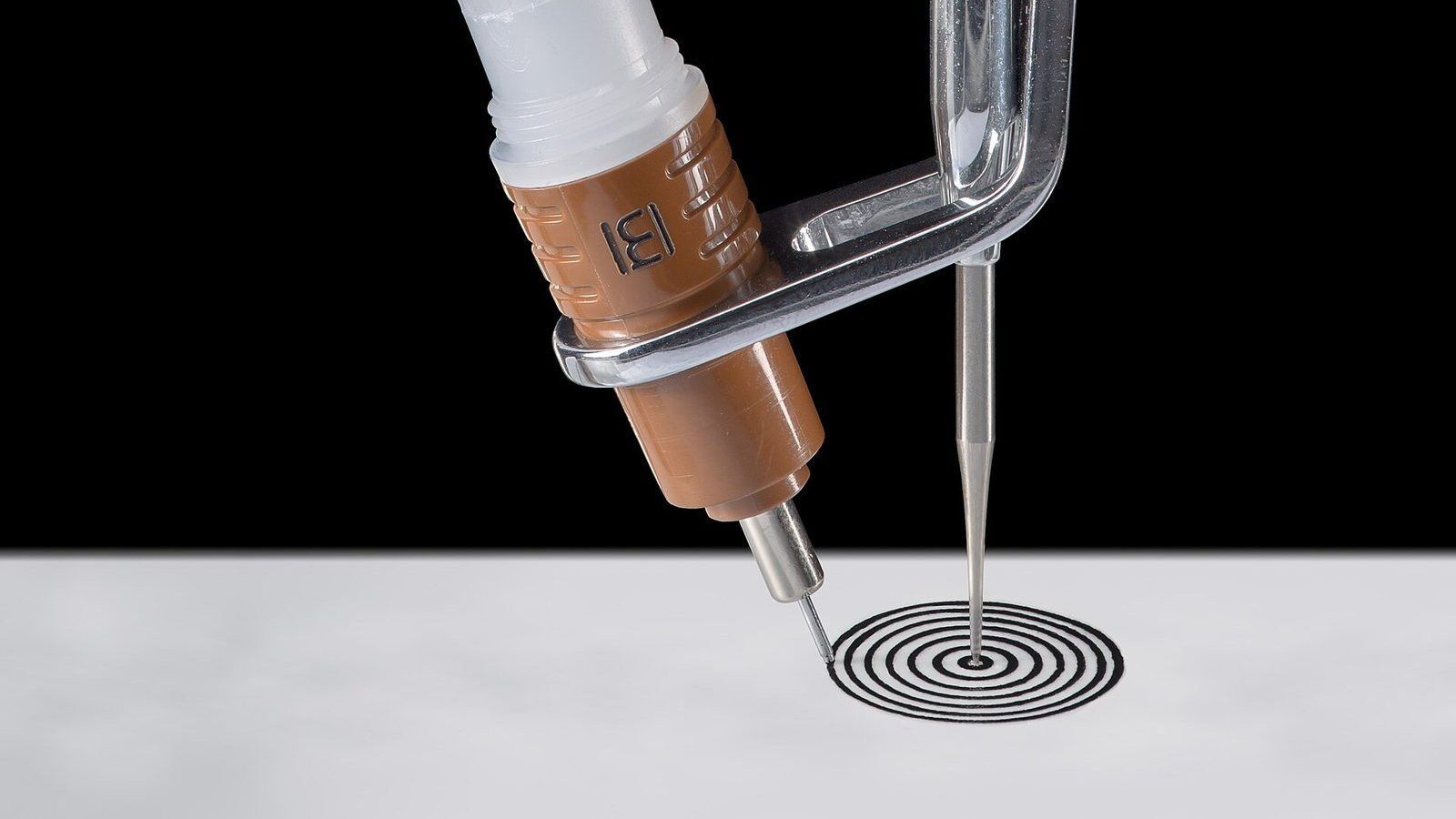
The instruments are idealized. The ruler has no markings and is used only to draw the straight line through two points already constructed. The compass draws the circle centred at one constructed point and passing through another. One starts with two points, and every further point must be an intersection of two lines, a line and a circle, or two circles that have already been drawn. Change the rules even slightly and the problem changes: Archimedes trisected any angle with a ruler carrying two marks, and a sheet of paper folded according to the rules of origami also does it, by a method published by Hisashi Abe in 1980. The impossibility is a statement about the two instruments as Euclid used them.
From drawings to numbers
Put coordinates on the page with the two starting points at \((0, 0)\) and \((1, 0)\). A constructed point has coordinates, and the question becomes which numbers can appear as coordinates. A line through two constructed points has an equation \(ax + by = c\) whose coefficients are built from the coordinates of those points by addition, subtraction, and multiplication. A circle has an equation \((x - p)^2 + (y - q)^2 = r^2\) with the same property. Intersecting two lines means solving two linear equations, which involves only the four arithmetic operations. Intersecting a line with a circle, or two circles, means solving a quadratic, which involves the four operations and one square root.
So every constructible number lies in a field obtained from the rationals by a finite sequence of steps, each of which adjoins the square root of a number already present. In the language of Unit 13, there is a tower of fields \(\mathbb{Q} = F_0 \subset F_1 \subset \cdots \subset F_m\) with each step of degree 2, and the constructible number lies in \(F_m\). The tower law says that the degree of \(F_m\) over \(\mathbb{Q}\) is the product of the degrees of the steps, which is \(2^m\). And the degree of a single number \(\alpha\), defined as the degree of the lowest-degree polynomial with rational coefficients having \(\alpha\) as a root, divides the degree of any field containing it, by the tower law once more. The conclusion is a clean necessary condition:
If a number is constructible, its degree over the rationals is a power of 2.
That is the whole theory. What remains is to find an angle whose trisection would require a number of degree 3.
The angle of 60 degrees
An angle of 60 degrees is constructible, since an equilateral triangle is. Trisecting it means constructing an angle of 20 degrees, which means constructing the number \(\cos 20°\), because from that number the angle follows by one more line and circle. The triple-angle formula from trigonometry, which is itself just algebra applied to de Moivre's formula of Unit 3, says \(\cos 3\theta = 4\cos^3\theta - 3\cos\theta\). With \(\theta = 20°\) and \(\cos 60° = 1/2\), the number \(c = \cos 20°\) satisfies
\[ 8c^3 - 6c - 1 = 0. \]Is this cubic the lowest-degree polynomial with \(c\) as a root, or does it factor? The rational root theorem of Unit 2 says that any rational root would be of the form \(\pm 1, \pm 1/2, \pm 1/4\), or \(\pm 1/8\), and trying the eight candidates shows that none works: for instance \(8 \cdot \frac18 - 6 \cdot \frac12 - 1 = 1 - 3 - 1 = -3\). A cubic with no rational root cannot factor over the rationals, since any factorization would include a linear factor. So \(8x^3 - 6x - 1\) is irreducible, \(\cos 20°\) has degree 3, and 3 is not a power of 2. The angle of 60 degrees cannot be trisected, and therefore there is no general method for trisecting angles.
Some angles can be trisected, which confuses the issue for amateurs. A right angle can, because 30 degrees is constructible. So can 180 degrees, and so, trivially, can any angle that was itself obtained by tripling a constructible one. The theorem says that no single procedure works for every angle, and it exhibits one specific angle, as common as any, for which no procedure works at all.
The cube and the circle
The same argument settles the second classical problem. Doubling the cube, the problem that the oracle at Delos is said to have set the Athenians during a plague, asks for a cube of twice the volume of a given one, which means constructing \(\sqrt[3]{2}\). That number is a root of \(x^3 - 2\), irreducible by the rational root theorem or by Eisenstein's criterion, so it has degree 3 and is not constructible. Wantzel's paper of 1837, in Liouville's journal, dealt with the trisection and the cube together and also completed Gauss's theorem on which regular polygons can be drawn, as the previous article described.
The third classical problem, squaring the circle, asks for a square with the area of a given circle, which means constructing \(\sqrt\pi\) and hence \(\pi\). The degree argument needs to know the degree of \(\pi\) over the rationals, and the answer, found by Ferdinand von Lindemann in 1882, is that \(\pi\) has no degree at all: it is a root of no polynomial with rational coefficients. Such numbers are called transcendental, and the proof is analysis rather than algebra, which is why the masterclass states Lindemann's theorem and does not prove it. With it, the three problems that the Greeks could not solve were shown, 2200 years later, to have no solution.
Wantzel
Pierre Laurent Wantzel (1814-1848) was an engineer by training who taught at the École polytechnique and the École des Ponts et Chaussées. His paper of 1837, Recherches sur les moyens de reconnaître si un problème de géométrie peut se résoudre avec la règle et le compas, is seven pages long and settled two of the most famous problems in mathematics, and it was almost entirely ignored. Nineteenth-century histories attributed the impossibility to Gauss, who had asserted it without proof, or left it out; Wantzel's name began to appear in textbooks only in the twentieth century. He died at 33, worked to death by his own account, having also given in 1845 a corrected proof of the Abel-Ruffini theorem that was shorter than Abel's. The MacTutor biography has what little is known.
Unit 13 of the masterclass proves everything above properly: the degree of a field extension as a dimension, the tower law, the minimal polynomial, and the criterion for constructibility, with the three classical problems and the regular polygons as the applications. It is also where the \(\sqrt{2}\) of Unit 1 and the \(\sqrt[3]{2}\) of Unit 2 reappear, as numbers of degree 2 and 3 whose difference decides a question the Greeks asked. The curriculum shows where it falls.