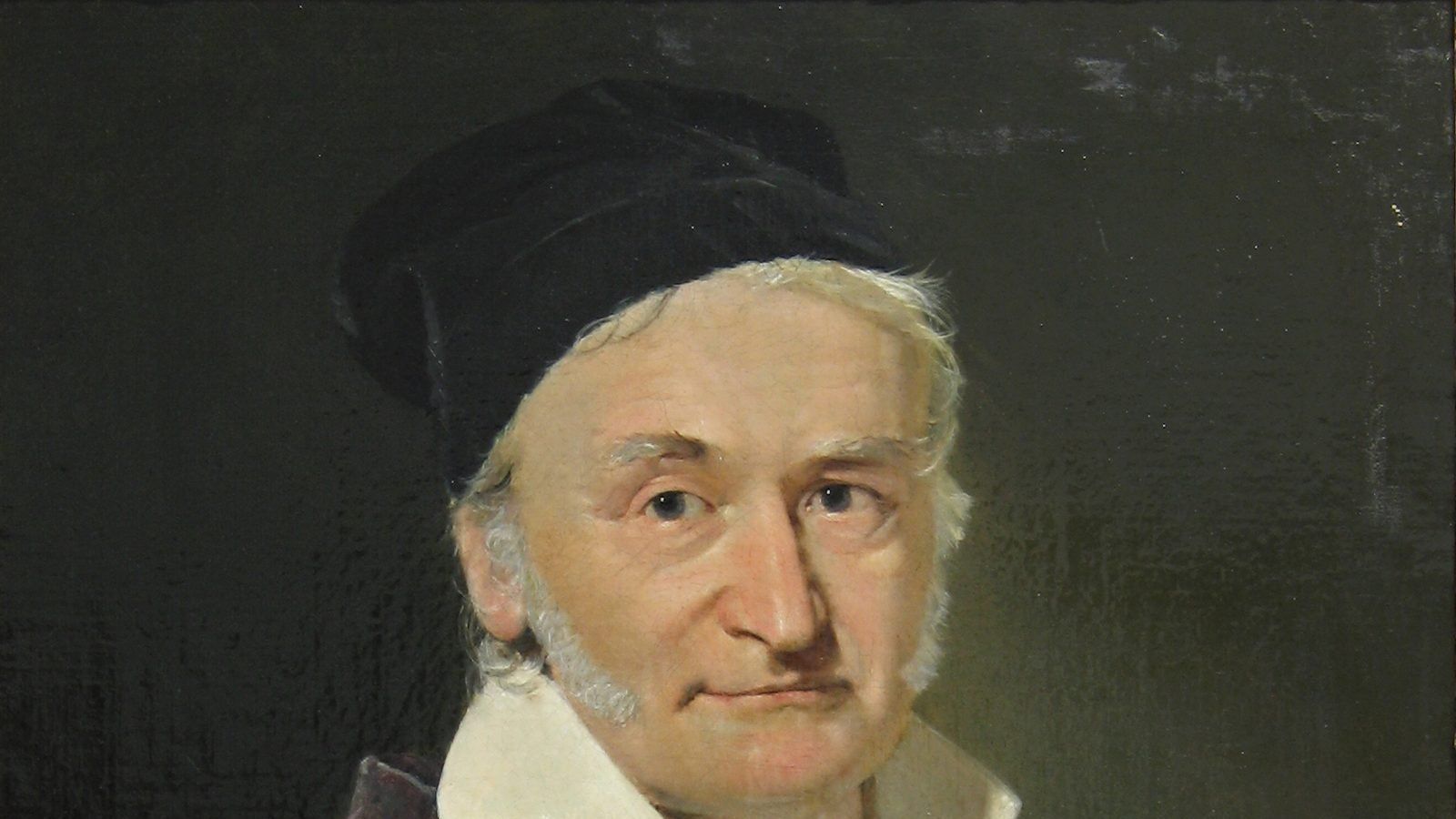
 Image: Christian Albrecht Jensen (public domain)
Gauss and the 17-gon
Euclid's Elements show how to construct, with an unmarked ruler and a compass, an equilateral triangle, a square, a regular pentagon, and a regular 15-gon, and from any constructible polygon the one with twice as many sides, by bisecting angles. That gave the Greeks regular polygons with 3, 4, 5, 6, 8, 10, 12, 15, 16, 17 sides? No. For 7, 9, 11, 13, 14, 17, 18, and 19 sides nobody could find a construction, and for 2000 years nobody added a single new polygon to Euclid's list. On the morning of 30 March 1796, Carl Friedrich Gauss, aged 18 and still undecided between mathematics and philology, saw while lying in bed that the regular 17-gon could be constructed. He chose mathematics. The entry is the first in the mathematical diary he began that day and kept for 18 years.
What a construction is
A ruler draws the line through two known points, and a compass draws the circle through one known point centred at another. Starting from two points at distance 1, the new points one obtains are intersections of such lines and circles. Writing the points as coordinates, a line through two known points has an equation of degree 1 and a circle an equation of degree 2, so each new point has coordinates that solve, at worst, a quadratic equation whose coefficients are previously known numbers. Every constructible number is therefore reachable from the rationals by a finite chain of square roots. Conversely, square roots can be constructed, by a semicircle, so the constructible numbers are exactly the numbers built from rationals by the four operations and square roots.
Constructing the regular \(n\)-gon amounts to constructing the number \(\cos(2\pi/n)\), or equivalently the complex number \(\zeta_n = e^{2\pi i/n}\), the first of the \(n\)-th roots of unity from Unit 3. For the pentagon, \(\cos 72° = (\sqrt 5 - 1)/4\), one square root, and Euclid's construction uses it. For the heptagon, \(\cos(2\pi/7)\) is a root of \(8x^3 + 4x^2 - 4x - 1\), an irreducible cubic, and a chain of square roots cannot reach a root of an irreducible cubic, for the reason the trisection article explains: each square root at most doubles the degree, so a constructible number has degree a power of 2, and 3 is not one.
Why 17 works
The number \(\zeta_{17}\) satisfies \(x^{16} + x^{15} + \cdots + x + 1 = 0\), which is irreducible, so \(\zeta_{17}\) has degree 16 over the rationals, and 16 is a power of 2. That is necessary and turns out to be sufficient, and Gauss's insight was how to arrange the 16 roots so that the square roots appear one at a time.
The 16 non-trivial 17th roots of unity are \(\zeta, \zeta^2, \ldots, \zeta^{16}\). The exponents 1 to 16 form a group under multiplication modulo 17, which is cyclic of order 16, and 3 generates it: the powers of 3 modulo 17 run \(3, 9, 10, 13, 5, 15, 11, 16, 14, 8, 7, 4, 12, 2, 6, 1\). List the roots in that order. Now split the list into the even-numbered positions and the odd-numbered positions, and let \(\eta_1\) and \(\eta_2\) be the two sums of eight roots each. Gauss showed that \(\eta_1 + \eta_2 = -1\) and \(\eta_1\eta_2 = -4\), so the two sums are the roots of \(x^2 + x - 4\), namely \((-1 \pm \sqrt{17})/2\). Split each sum of eight in the same way into two sums of four; each pair of sums of four satisfies a quadratic with coefficients in the previous level. Split again into sums of two, which are \(\zeta^k + \zeta^{-k} = 2\cos(2\pi k/17)\), and once more into single roots. Four levels, four square roots, and the final formula is
\[ 16\cos\frac{2\pi}{17} = -1 + \sqrt{17} + \sqrt{34 - 2\sqrt{17}} + 2\sqrt{17 + 3\sqrt{17} - \sqrt{34 - 2\sqrt{17}} - 2\sqrt{34 + 2\sqrt{17}}}. \]The chain of sums is possible because 16 is a power of 2 and halves evenly at every level; for 7 the group of exponents has order 6, which halves once to 3 and then stops, and a cubic is left. The sums Gauss used are now called Gaussian periods, and the method is Galois theory for the cyclotomic field forty years before Galois: the groups of Unit 14 are standing in the background of a calculation done by an eighteen-year-old in 1796.
Which polygons, then
Gauss published the full theory in 1801 as the seventh and last section of the Disquisitiones Arithmeticae, and the result reads: a regular \(n\)-gon is constructible if \(n\) is a power of 2 times a product of distinct primes of the form \(2^{2^k} + 1\). Such primes are called Fermat primes, after Fermat's conjecture of 1640 that every number of that form is prime. The known ones are 3, 5, 17, 257, and 65537, for \(k = 0\) to 4; Euler showed in 1732 that the next, \(2^{32} + 1 = 4{,}294{,}967{,}297\), is \(641 \times 6{,}700{,}417\), and no further Fermat prime has been found, with every \(k\) up to 32 now known to give a composite number. So the constructible polygons with an odd number of sides are those with 3, 5, 15, 17, 51, 85, 255, 257, ... sides, 31 of them in all if no more Fermat primes exist, the largest with \(3 \times 5 \times 17 \times 257 \times 65537 = 4{,}294{,}967{,}295\) sides.
Gauss stated that his condition was also necessary, that no other polygon can be constructed, and wrote that he could prove it but that the limits of the work did not allow it. The proof was supplied by Pierre Wantzel in 1837, in the same paper that disposed of the trisection and the doubling of the cube, using exactly the degree argument above. The theorem is sometimes named after both.
Drawing it
Gauss gave the formula, not a drawing. The first explicit construction of the 17-gon was published by Johannes Erchinger in 1825, and the neatest one in common use, taking about 60 steps, is due to H. W. Richmond in 1893. The 257-gon was constructed by Friedrich Julius Richelot in 1832, in 194 pages. The 65537-gon was taken on by Johann Gustav Hermes, a schoolteacher in Lingen, who spent ten years on it and deposited his manuscript, which fills a trunk, with the University of Göttingen in 1894. It is still there, and nobody has checked it.
Gauss asked that a 17-gon be carved on his gravestone. The stonemason refused, saying that it would be indistinguishable from a circle, and the memorial in his birthplace of Braunschweig carries a 17-pointed star instead. The MacTutor biography follows the rest of the life, which included the Disquisitiones at 24, the orbit of Ceres, the method of least squares, the geometry of curved surfaces, and the first electric telegraph.
In the masterclass the theory of constructible numbers is in Unit 13, which proves the degree criterion with the tower law for field extensions and applies it to the three classical problems and to the polygons, with the 17-gon as the worked example of a constructible one and the heptagon as the worked example of an impossible one. Unit 8 tells the story as part of the long search for a formula for the roots of equations, of which the roots of unity are the first and friendliest case. The curriculum has the order of the units.