 Image: Unknown author (public domain)
Emmy Noether and the algebra of structure
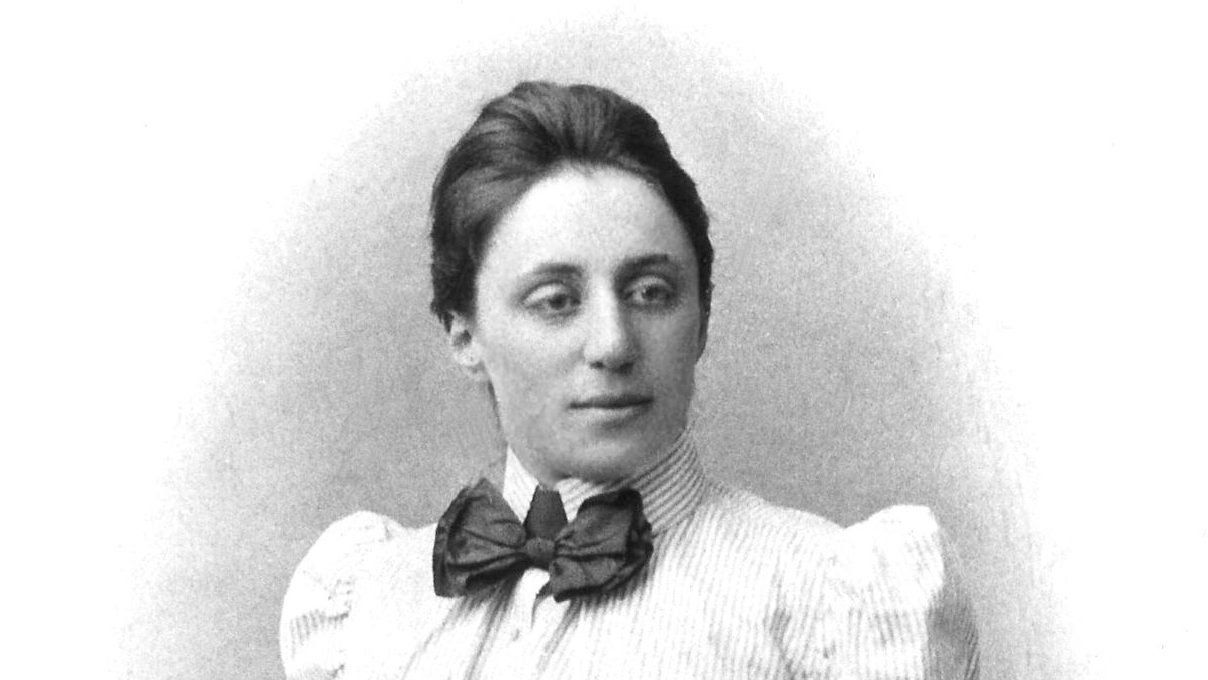
In the spring of 1935 Albert Einstein wrote to the New York Times that Emmy Noether, who had died a few weeks earlier at the age of 53, was the most significant creative mathematical genius produced since the higher education of women had begun. The letter was published on 4 May. Most readers would not have heard of her. Ninety years later, every algebra textbook is organized the way she organized the subject, physicists invoke her theorem whenever they speak of a conservation law, and the adjective Noetherian is attached to rings, schemes, and spaces in every branch of mathematics.
Erlangen
Amalie Emmy Noether was born on 23 March 1882 in Erlangen, where her father Max Noether was a professor of mathematics. Women could not enrol at German universities. She sat in on the mathematics teaching at Erlangen as an auditor from 1900, with the individual permission of each professor, passed the examination that would have admitted a man, and when Bavaria opened its universities to women in 1904 she enrolled and wrote a doctorate under Paul Gordan, the "king of invariants", in 1907. The thesis computed 331 invariants of a certain kind of form by hand, in the style of Gordan's school. She later described it as a jungle of formulas and dismissed it, which was unfair to the work and accurate about the direction she then took.
For the next eight years she worked at Erlangen without position or salary, substituting for her father when he was ill, and taught herself the new approach of David Hilbert, who had shown in 1890 that the invariants Gordan computed one by one could be proved to exist all at once by an abstract argument, without computing any of them. Gordan had called Hilbert's proof theology. Noether became its best practitioner.
Göttingen and the senate
In 1915 Hilbert and Felix Klein invited her to Göttingen, the centre of mathematics in the world at the time, to help with the mathematics of general relativity, which Einstein was finishing that year. The faculty proposed her for the habilitation, the qualification required to teach at a university. The philosophical faculty, which included the historians and philologists, voted it down; one member asked what the soldiers returning from the war would think when they found themselves expected to learn at the feet of a woman. Hilbert's reply, as his colleague Hermann Weyl recorded it in the memorial address of 1935, was that he did not see why the sex of the candidate was an argument against her admission, since this was a university and not a bathhouse. She taught for the next four years under Hilbert's name, with announcements reading "Professor Hilbert, with the assistance of Fräulein Dr. E. Noether", and was paid nothing.
The habilitation was granted in 1919, after the Weimar constitution had changed the rules, and she received the title of extraordinary professor in 1922 and a small salary the following year, which remained the whole of her official position in Germany.
The theorem physicists know
Her first Göttingen work was on the question Hilbert and Klein had invited her for. In the paper Invariante Variationsprobleme of 1918 she proved two theorems, of which the first is now simply called Noether's theorem: for a physical system described by an action principle, every continuous symmetry of the action gives a conserved quantity. If the laws are the same at every moment, energy is conserved; if they are the same at every place, momentum is conserved; if they are the same in every direction, angular momentum is conserved. The theorem converts a question about what stays the same under a symmetry group into a question about what stays the same in time, and it is the reason the symmetry groups of Units 5 and 10 are the central objects of modern physics. An English translation of the paper is on the arXiv. The second theorem, concerning symmetries that depend on arbitrary functions, resolved the puzzle about energy in general relativity that had prompted the invitation.
She regarded this as a side project. Physicists took fifty years to realize what it contained, and the paper's citations grew mainly after 1970, when gauge symmetry became the organizing principle of particle physics.
The paper algebraists know
In 1921 she published Idealtheorie in Ringbereichen, "Theory of ideals in rings", in the Mathematische Annalen, and this is the paper that made algebra what it is. The objects called ideals had been introduced by Dedekind for rings of algebraic integers and used by Lasker, the chess champion, for rings of polynomials, with proofs that depended on the specific arithmetic of each. Noether asked what a ring must satisfy for the theorems about ideals to hold, and found that one condition sufficed: every increasing chain of ideals must eventually stop. From this one axiom, now called the ascending chain condition, she derived the decomposition of every ideal into primary ideals in complete generality, for all rings at once. Rings satisfying the condition are called Noetherian, and most rings anyone cares about are.
The method was the point. Instead of calculating with the elements of a particular ring, she worked with the structure: the ring, its ideals, the maps between rings, and the properties preserved by those maps. Her students called it begriffliche Mathematik, conceptual mathematics, and the Göttingen circle around her, the Noether boys, carried it everywhere. Bartel van der Waerden's textbook Moderne Algebra of 1930 and 1931, written up from what she taught in Göttingen and Emil Artin in Hamburg, fixed the order in which the subject is still taught: groups, then rings, then fields, each defined by axioms and studied through its substructures and homomorphisms. The masterclass follows that order, and the definitions of ring and ideal in Units 7 and 12, with the quotient ring \(F[x]/(f)\) as the construction of a finite field, are hers in form and spirit.
Her later work, in the 1920s and early 1930s, made the same move for non-commutative algebras and representations of groups, which she rebuilt as vector spaces on which a group ring acts, and for the arithmetic of number fields. She published little under her own name relative to her influence; many of her ideas appeared in the papers of her students and in Hasse's and Artin's, with a line of acknowledgement.
1933
On 7 April 1933 the new government passed the law that removed Jews and political opponents from the civil service, and Noether, who was both Jewish and a known pacifist of the left, was among the first six Göttingen professors dismissed, on 25 April. She continued to teach her seminar in her apartment until she left. The Rockefeller Foundation and Emergency Committee found her a visiting position at Bryn Mawr, a women's college in Pennsylvania, with weekly talks at the Institute for Advanced Study in Princeton, which she described as a men's university where nothing female was admitted. She died on 14 April 1935, four days after surgery to remove a tumour, when a post-operative infection took hold. Weyl's memorial address, Einstein's letter, and van der Waerden's obituary in the Annalen are the three documents from which most of her biography is drawn; the MacTutor biography draws on all three.
Göttingen, which had refused her a lectureship, lost with her and the other dismissed mathematicians the position it had held for a century. Asked by the new minister in 1934 whether the institute had suffered from the departure of the Jews, Hilbert is reported to have answered that it had not suffered, since it no longer existed.
In the masterclass, rings are the subject of Unit 7 and polynomial rings and their quotients of Unit 12, and the ascending chain condition appears in Unit 12 as the reason a polynomial over a field factors into irreducibles in finitely many steps. The curriculum says where those units fall.