The quadratic formula, found by completing the squareUnit 1, The Algebraist's Toolkit
Our alumni study at
xthe unknown
About the program
The Algebra Masterclass takes you through algebra one unit at a time. You enrol, and from then on a new unit reaches you every week. Each unit is a chapter written for this program, with complete proofs, worked examples, and the published research of mathematicians who are active today.
A quiz completes every unit and opens the next. At the end you sit a final exam and receive a certificate with a public verification page.
Structured. A fixed sequence of units that starts with polynomials and ends with the groups and fields of modern algebra.
Demanding and fair. Every theorem comes with a proof, and every proof is written out in steps you can check with pencil and paper.
Recognized. A certificate and a transcript, both with a verification ID that anyone can check online.
Al-Khwarizmi's example, completed with a square of 25(Unit 1)
Al-Khwarizmi's Algebra, written in Baghdad around 820. Its quadratic equations are solved by drawing squares and completing them.Image: Bodleian Library, University of Oxford
∈belongs to
Who is this program for?
For high school students, university students, and lifelong learners. You need no experience with proofs or with abstract algebra: Unit 1 gives every participant the same toolkit.
High School Students
You enjoy the moment an equation gives way. The masterclass takes you past school algebra to symmetry, groups, and fields, and prepares you for olympiads such as the IMO.
School mathematics is enough
Certificate for applications
Every step of a proof written out
University Students
A companion to a degree in mathematics, physics, or computer science. Use it to prepare for a first course in abstract or linear algebra, a thesis, or the Putnam.
Complete proofs and worked examples
Current research papers
A base for a first project
Lifelong Learners
You remember solving for x and wondered what came after it. The masterclass goes step by step, from polynomials to the groups that describe symmetry, at your pace.
No deadlines, pause any time
Unit 1 refreshes the notation
Read on screen or as PDF
↦maps to
How does it work?
Six steps, each of which opens the next.
1
Step 1: Enrol
Create your account with your email address, choose your masterclass, and pay the Tuition Fee. Your program starts at once.
2
Step 2: Receive your unit
Unit 1 arrives immediately and every further unit on a Monday, as a web page and as a PDF to keep.
3
Step 3: Study
Work through the proofs and the worked examples, and answer the questions in the text as you go. A day later we send further reading, including research papers that are free to read.
4
Step 4: Take a quiz for every unit
Each unit has its own quiz: ten questions, open book, no time limit. You submit it before the next unit is sent to you.
5
Step 5: Sit the final exam
50 questions across the units of your masterclass in 60 minutes, open book. You pass with 70% and have up to 3 attempts.
6
Step 6: Earn your certificate
Certificate and transcript as PDF, each with a verification ID and a personal link you can share.
∘composed with
Topics
Sixteen units in three groups, each built on the one before. Foundation ends after Unit 8, Advanced after Unit 12, and Advanced + Galois Theory continues to Unit 16.
1 to 8
Equations and Symmetry
Units 1 to 8, in all three masterclasses
Polynomials and their roots, complex numbers, matrices, the symmetries of a square, permutations, and rings and fields, with a closing unit on how modern algebra began.
Lagrange's theorem, and Fermat's little theorem as a consequence of it, for every prime p and every a not divisible by p.(Unit 9)
13 to 16
Galois Theory
Units 13 to 16, in Advanced + Galois Theory
Constructions that cannot be done with ruler and compass, the group of a polynomial's roots, the proof that the quintic has no formula, and which groups occur as Galois groups.
Doubling the cube needs a field of degree 3, so ruler and compass cannot do it (Unit 13). The group of x⁵ − 6x + 3 is S₅, which is not solvable, so its roots have no formula in radicals (Unit 15).(Units 13 and 15)
Every unit has a research spotlight: the published work of a mathematician active today, explained at your level and linked to the original paper.
Log-concavity. June Huh, Karim Adiprasito, and Eric Katz proved it for the coefficients of the characteristic polynomial of every matroid.(Research spotlight, Unit 2)
The scientists named here are not contributors to the Algebra Masterclass, are not affiliated with it, and have not endorsed it. The program presents and explains their published research, with references to the original papers.
Choose the masterclass that fits you. Each one contains the one before it. One Tuition Fee, paid once, covers every unit, every quiz, the final exam, and your certificate.
8 weeks
Foundation
The fundamentals of algebra: proof, polynomials, complex numbers, matrices, groups, permutations, and rings and fields.
Tuition fees are one-time payments and include applicable taxes. Secure payment by card through Stripe.
The tower law: when fields sit one inside another, their degrees multiply.(Unit 13)
≅is isomorphic to
Your certificate
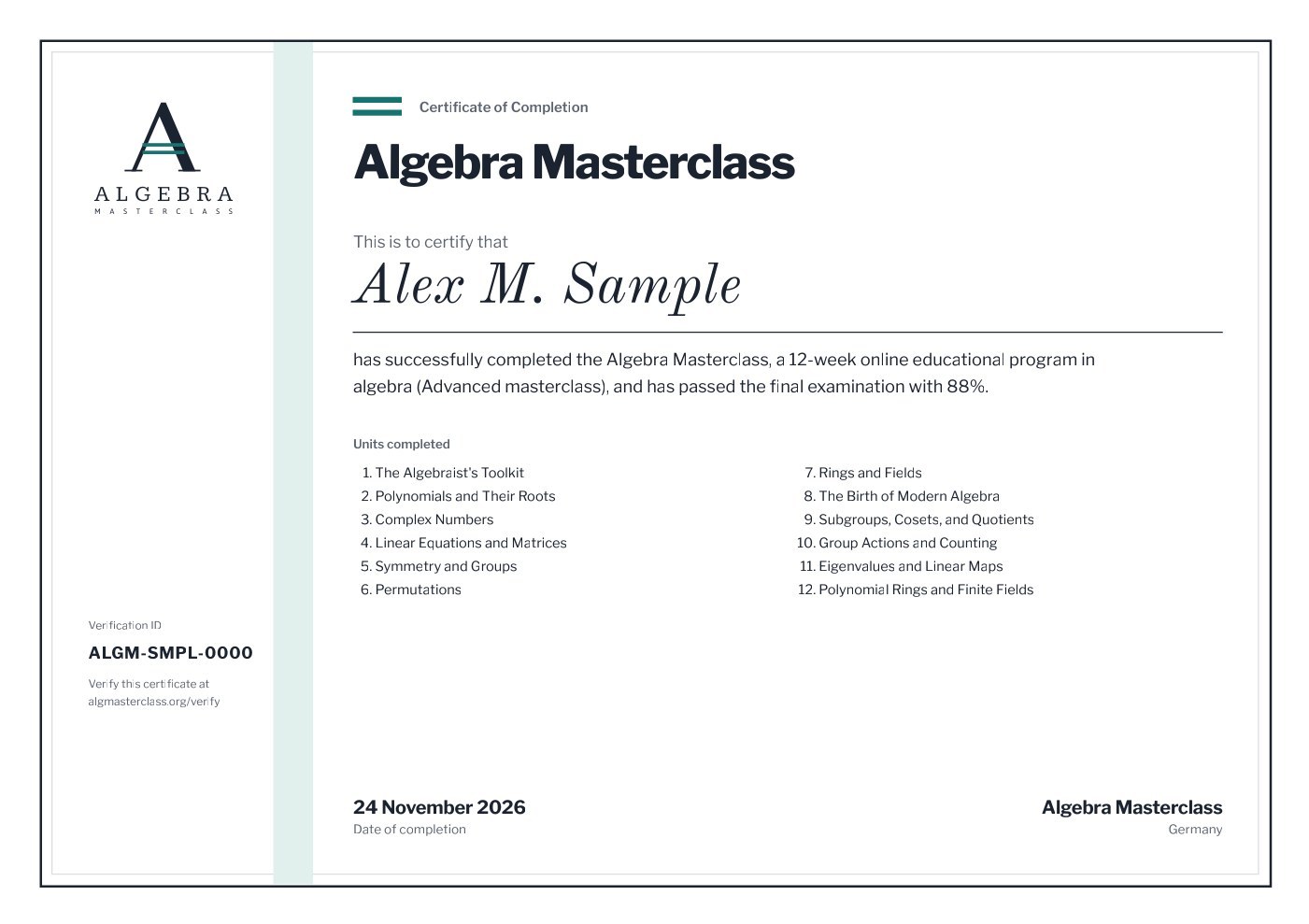
Participants who pass the final exam receive an official certificate of completion. It states your name, the masterclass, its duration, and the units you completed.
Certificate and transcript. The transcript lists your score in every unit quiz and in the final exam.
Verifiable. Both documents carry a verification ID that can be checked on this website.
Shareable. Your personal verification link shows your result to universities, scholarship committees, and employers.
Read one complete unit before you enrol, exactly as participants receive it: the full text with its proofs, worked examples, figures, and research spotlight.
Unit 3, 15 pages
Complex Numbers
Why the square root of a negative number was forced on mathematicians, what complex numbers are and why the laws of arithmetic hold for them, the complex plane, polar form, de Moivre's formula and the roots of unity, the fundamental theorem of algebra with the idea of its proof, and a closing look at iteration, the Mandelbrot set, and Newton's method in the plane.
Euler's formula, taken as a definition in this unit and checked against the rules of multiplication(Unit 3)
By the end of the unit you can answer
How can a formula that passes through √(-121) arrive at the real answer 4?
What are complex numbers, and why do the ordinary laws of arithmetic still hold for them?
Why does multiplying by i turn the plane through a right angle, and what does multiplying by 1 + i do?
Where do the five fifth roots of unity lie, and why do they add up to zero?
What does the fundamental theorem of algebra say, and why does it follow that every real polynomial is a product of linear and quadratic factors?
Masterclass participants come from all over the world, and when you complete the program you stay part of a network that keeps you close to mathematics.
Mathematics academics in our community
2000+
Countries represented
90+
Schools and universities represented
750+
Alg-Connect
Our alumni program introduces former participants to one another across countries: for study advice, exchange about university applications, and shared projects.
Opportunities
Past participants hear from us about scholarships, competitions, summer schools, and other academic opportunities in mathematics.
A place in mathematics
The program shows you how research in algebra is done and where it happens, so that your next step at school, at university, or beyond is an informed one.
Algebra is one of the four areas of the International Mathematical Olympiad, and its problems look nothing like school algebra. Here is what the syllabus actually contains, which theorems you need, where the theory in this masterclass helps and where it does not, and how to practise.
The largest of the 26 sporadic simple groups has about 8 times 10^53 elements and was built by hand in 1980. Its smallest representation has dimension 196,883, and a function from the theory of elliptic curves has the coefficient 196,884. The coincidence turned out to be a theorem.
She was refused a lectureship because she was a woman, taught under a man's name, and in 1921 wrote the paper that turned algebra from the study of equations into the study of structures. Physicists know her for a different theorem altogether.
For high school students, university students, and lifelong learners. High school students use it to learn the algebra behind olympiad problems properly and to prepare for university applications. University students in mathematics, physics, computer science, or chemistry take it next to their degree, before or during their first lectures in abstract or linear algebra. Lifelong learners, among them many who can solve a Rubik's Cube or remember solving for x and wondered what came next, use it to see what algebra became after school. The Foundation masterclass suits a first contact with the subject; the Advanced masterclass goes on to quotient groups, group actions, eigenvalues, and finite fields.
What do I need to know before I start?
School algebra is enough: fractions, powers, expanding and factorizing, quadratic equations, and the graph of a function. You do not need any experience with proofs, complex numbers, matrices, or groups. Unit 1 teaches what a proof is, direct proof, contradiction, and induction, and every later unit uses them. Complex numbers are built from scratch in Unit 3, matrices in Unit 4, and the group axioms are read off the symmetries of a square in Unit 5. There is no calculus anywhere in the program.
How much time do I need each week, and are there live sessions?
Most participants spend three to five hours a week: two or three hours on the unit, under an hour on the open-book quiz, and the rest on the further reading if they want it. A unit with long proofs, such as the one on cosets and quotient groups, takes longer if you work through every proof with pencil and paper, which we recommend. The program is fully online and has no live sessions, so it works in every time zone and next to school, university, or work. You receive the units by email and read them on the website or as PDF. Quizzes and the final exam are taken on the website.
Can I finish the program in less than 12 weeks?
Yes. A new unit is scheduled for every Monday, but once you have submitted the quiz of a unit you can ask for the next one ahead of schedule, from your dashboard or from the email we send you. The earliest moment is 24 hours after the previous unit was sent. We recommend the weekly rhythm, because new structures need time to settle, but the pace is your decision.
What happens if I fall behind or have to pause?
Nothing is lost. The next unit is only sent once you have submitted the quiz of the current one, so the program waits for you. You can pause for a week or for a term and continue at any time. There is no penalty and no deadline.
How does the final exam work?
After the last unit you sit the final exam online: 50 multiple-choice questions across all units of your masterclass, drawn individually for each participant, with a time limit of 60 minutes. It is open book. You pass with 70% correct answers. If you do not pass, you can try again after 3 days with new questions, up to 3 attempts in total.