

The Birth of Modern Algebra
The closing unit of the Foundation masterclass tells the story: the long search for a formula from al-Khwarizmi to the quintic, Lagrange's resolvent, the Abel-Ruffini theorem, Galois and the group of a polynomial computed by hand for three examples, the abstraction of the nineteenth century, Emmy Noether, the classification of finite simple groups and the Monster, and where algebra is used today.
For a thousand years algebra meant one thing, to solve equations, and for three hundred of those years the best mathematicians in Europe searched for a formula that would solve the equation of degree five as Cardano’s formula solves the cubic. The search failed, and the reason for the failure turned out to be more valuable than any formula. A twenty-year-old in Paris saw that the roots of an equation have a symmetry group, that the group decides whether a formula exists, and that the right objects of algebra are the structures themselves, the groups, rings, and fields that the last seven units have introduced one by one. This unit tells that story up to the present day, computes its small examples by hand, and ends with a map of what lies beyond the Foundation masterclass.
1 The search for a formula
al-Khwarizmi (around 780 to around 850) solved quadratic equations by completing the square around 820, with a drawing of the square (Unit 1). The cubic resisted for seven centuries, until Scipione del Ferro (1465-1526) found the method for the depressed cubic \(x^3 + px = q\) and Girolamo Cardano (1501-1576) published it in the Ars Magna (1545) together with the reduction of the general quartic to a cubic that his assistant Lodovico Ferrari (1522-1565) had found. Unit 2 derived Cardano’s formula, and Unit 3 showed that it passes through square roots of negative numbers even when all three roots are real. Figure 1 places these dates on a line with the ones that follow.
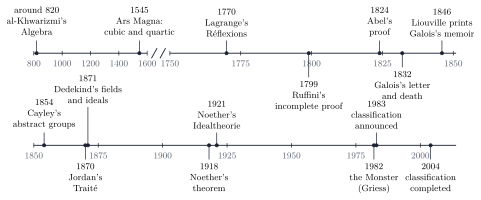
After 1545 the next step seemed obvious. A formula for degree 5 was expected within a generation, and it did not come. The breakthrough that eventually ended the search was a change of question. In 1770 and 1771 Joseph-Louis Lagrange (1736-1813) published, in two parts, his Réflexions sur la résolution algébrique des équations, in which he stopped looking for new tricks and instead asked why the known formulas worked. His answer was that every formula for the cubic and the quartic rests on an auxiliary quantity built from the roots, and that what matters about this quantity is how many different values it takes when the roots are permuted.
1.1 Lagrange’s resolvent
Take a cubic with roots \(r_1\), \(r_2\), \(r_3\), and let \(\omega = e^{2\pi i/3}\) be the cube root of unity of Unit 3, so that \(\omega^3 = 1\) and \(1 + \omega + \omega^2 = 0\). Lagrange considered the expression \[ s = r_1 + \omega r_2 + \omega^2 r_3 . \] The six permutations of the roots (Unit 6) turn \(s\) into six expressions, and in general these are six different numbers. Lagrange’s observation is that their cubes are not six different numbers.