 Image: Cone83 (CC BY-SA 4.0)
Hamilton on Broom Bridge
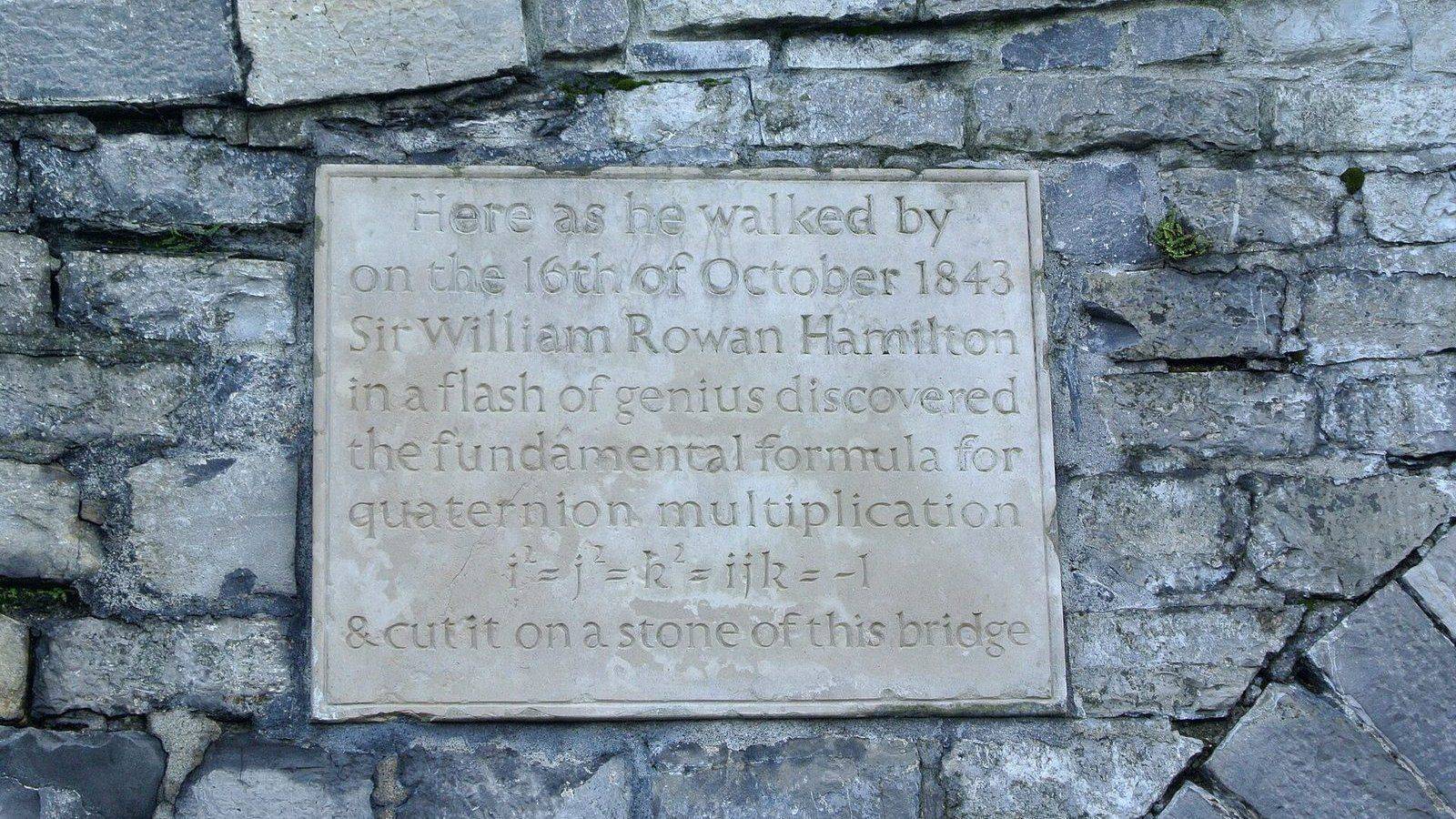
The plaque on Broom Bridge, over the Royal Canal in the Cabra district of Dublin, says that Sir William Rowan Hamilton, walking by on 16 October 1843, "in a flash of genius discovered the fundamental formula for quaternion multiplication" and cut it on a stone of the bridge. The carving, if it existed, is long gone. The formula is still there on the plaque, and it is short:
\[ i^2 = j^2 = k^2 = ijk = -1. \]What it records is the first time anyone built a number system in which \(ab\) and \(ba\) are different numbers. Algebra had been commutative since the Babylonians. After that walk it was not, and most of the structures the masterclass studies from Unit 4 onwards, matrices and groups above all, live on the other side of that line.
The problem Hamilton was trying to solve
By the 1830s it was understood, through the pictures of Wessel and Argand, that a complex number \(a + bi\) is a point in the plane, and that multiplying by a complex number rotates and stretches the plane. Hamilton himself had published in 1835 a definition of complex numbers as ordered pairs of real numbers with a rule for multiplying pairs, the definition that Unit 3 uses. The natural next question was whether triples of real numbers could be multiplied in the same way, to give an algebra of rotations in three-dimensional space. Hamilton worked on it for about ten years. His sons, he wrote later, used to ask him at breakfast whether he could multiply triplets yet, and he had to answer that he could only add and subtract them.
The reason triples fail is a theorem now, and a simple one. If \(a + bi + cj\) could be multiplied so that the usual laws held and lengths multiplied, the product \(ij\) would have to be some triple, and every choice leads to a contradiction. Hamilton found the way out on the walk to a meeting of the Royal Irish Academy, with his wife beside him: allow a fourth component. Let \(ij = k\), a new element, with \(ji = -k\), and the system closes up. He wrote to his son Archibald in 1865 that he could not resist the impulse to cut the formula into the stone of the bridge, and he wrote to his friend John Graves the next day with the full rules. The letter to Graves, dated 17 October 1843, is the first written account, and it is transcribed in full by the School of Mathematics at Trinity College Dublin.
How quaternions multiply
A quaternion is an expression \(q = a + bi + cj + dk\) with real \(a, b, c, d\). Addition is coordinate by coordinate. Multiplication follows from the single line on the plaque together with the distributive law. Multiplying \(ijk = -1\) on the left by \(i\) gives \(i^2 jk = -i\), so \(jk = i\); similar manipulations give \(ki = j\) and \(ij = k\), and then \(ji = -k\), \(kj = -i\), \(ik = -j\). The three symbols behave like the three axes of space, with the rule that multiplying two of them in cyclic order gives the third and in the other order gives minus the third.
Everything else about ordinary arithmetic survives. Multiplication is associative, so brackets can be dropped. There is a conjugate \(\bar q = a - bi - cj - dk\), and \(q\bar q = a^2 + b^2 + c^2 + d^2\), a non-negative real number, which means that every non-zero quaternion has an inverse \(\bar q / (q\bar q)\). The quaternions are therefore what Unit 7 calls a division ring, a ring in which division works, lacking only the commutative law that would make them a field. The eight quaternions \(\pm 1, \pm i, \pm j, \pm k\) form a group of order 8 under multiplication, the quaternion group \(Q_8\), which Unit 5 meets as the second non-abelian group of order 8 after the symmetries of the square, and which differs from it in having only one element of order 2.
Hamilton also noticed that \(|pq| = |p|\,|q|\), the length of a product is the product of the lengths, and that writing this out in coordinates gives Euler's identity of 1748 expressing a product of two sums of four squares as a sum of four squares. A century earlier that identity had been a curiosity; now it was the statement that quaternion multiplication preserves length.
Rotations
The application Hamilton wanted came out as follows. Take a quaternion \(q\) of length 1 and a point \((x, y, z)\) of space, written as the quaternion \(v = xi + yj + zk\) with no real part. Then \(qvq^{-1}\) is again a quaternion with no real part, and the map \(v \mapsto qvq^{-1}\) is a rotation of space. Every rotation arises this way, from exactly two quaternions \(q\) and \(-q\), and composing rotations corresponds to multiplying quaternions. A rotation by the angle \(\theta\) about the axis in the direction of \(u\), where \(u\) is a quaternion of length 1 with no real part, is given by \(q = \cos(\theta/2) + u\sin(\theta/2)\). The half angle is the reason for the two quaternions per rotation.
This is the form in which quaternions survived. For most of the twentieth century they were out of fashion, displaced by the vectors of Gibbs and Heaviside, who in the 1880s took Hamilton's "scalar part" and "vector part" and turned them into the dot product and the cross product. The revival came from engineering. Describing a rotation by three angles leads to a singularity when two axes align, known to pilots and animators as gimbal lock; describing it by a 3 by 3 matrix uses nine numbers for three degrees of freedom and drifts under rounding. A quaternion of length 1 uses four numbers, has no singularity, is easy to renormalize, and can be interpolated smoothly between two orientations. Since the 1980s quaternions have been standard in spacecraft attitude control, in flight simulators, in computer graphics and games, in robotics, and in the sensor fusion of every smartphone that knows which way up it is.
What was lost and what was gained
Hamilton spent the remaining 22 years of his life on quaternions and wrote two enormous books about them, convinced that they were the key to all of physics. That was too much to ask. What the discovery did do was break the assumption that an algebra had to be commutative, and within a few years the floodgates were open. Graves found the octonions, an eight-dimensional system that gives up associativity too, in December 1843, and Cayley published them in 1845. Cayley introduced matrices in 1858, with their non-commutative multiplication, and the abstract definition of a group he had given in 1854 took non-commutativity for granted. In 1877 Frobenius proved that the real numbers, the complex numbers, and the quaternions are the only finite-dimensional associative division algebras over the reals, so Hamilton's ten-year search had been for something that could not exist in dimension 3 and existed in exactly one way in dimension 4.
Every year on 16 October mathematicians from Maynooth University walk from Dunsink Observatory, where Hamilton lived and worked as Royal Astronomer of Ireland, to the bridge, a distance of about three kilometres, and the annual Hamilton Walk has been going since 1990. The MacTutor biography covers the rest of the life, including the optics and mechanics for which physicists remember him. In the masterclass, non-commutative multiplication first appears with matrices in Unit 4, the quaternions are the standard example of a division ring in Unit 7, and the group \(Q_8\) runs through Units 5 and 9. The curriculum has the details.