 Image: Unknown author (public domain)
Galois's last night
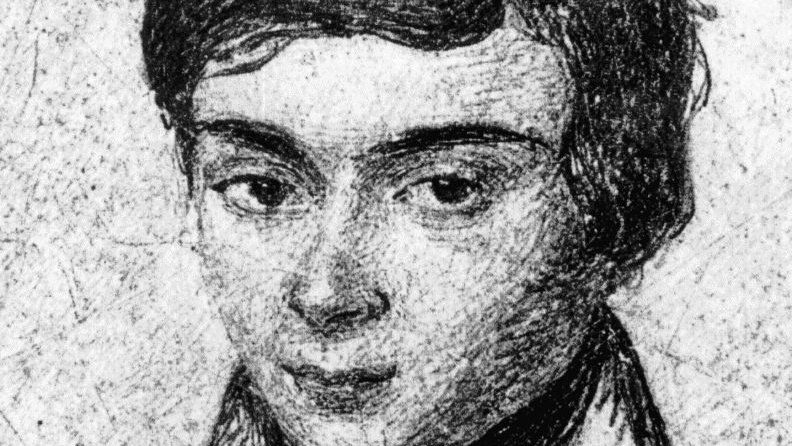
Évariste Galois was born on 25 October 1811 in Bourg-la-Reine, south of Paris, and died on 31 May 1832 in a Paris hospital, the day after a duel, at the age of twenty. In between he wrote about sixty pages of mathematics that were not understood during his life and that, once they were, became the foundation of the theory that carries his name. The story has been retold so many times, with so many improvements, that it is worth setting down what the documents actually say.
Two failures and a death
Galois read Legendre's geometry at fifteen and the memoirs of Lagrange soon after, and by seventeen he was doing original work on the solution of equations. In 1828 he sat the entrance examination of the École polytechnique, the best mathematics school in France, and failed. He sat it again in 1829 and failed again; the story that he threw a blackboard eraser at an examiner comes from a hostile later source and may or may not be true. What is documented is that between the two attempts his father, the liberal mayor of Bourg-la-Reine, killed himself in July 1829 after a campaign of forged letters by a local priest. Galois entered the less prestigious École préparatoire, later the École normale, in the autumn.
His first memoir on the solvability of equations was submitted to the Académie des sciences in May 1829, with Cauchy as referee. Cauchy did not report on it and seems to have encouraged Galois to revise and resubmit, which he did in February 1830 for the Academy's grand prize in mathematics. The secretary who received it, Fourier, died in May, and the manuscript was never found. The prize went to Abel, posthumously, and to Jacobi. Galois submitted a third version in January 1831. Poisson refused it in July with a report saying that the argument was neither clear enough nor developed enough to judge its correctness, and recommended that the author publish a fuller account. Poisson was not wrong about the clarity. He was wrong about the correctness.
Politics
The year 1830 was the year of the July Revolution, and Galois, locked inside the École normale during the three days of fighting, became a committed republican. He was expelled in January 1831 after a letter attacking the school's director appeared in a newspaper. In May 1831, at a republican banquet, he raised a glass to Louis-Philippe while holding an open knife, which was taken as a threat on the king's life; he was tried and acquitted. On 14 July 1831 he was arrested again, for wearing the uniform of the dissolved artillery of the National Guard, and this time he was sentenced to six months in the prison of Sainte-Pélagie. He read Poisson's rejection there. In March 1832, during the cholera epidemic, the prisoners were moved to a nursing home, and it was there, in his last two months of freedom, that the events leading to the duel began.
The duel
Who the opponent was and what the quarrel was about are not known for certain. Galois's own letters of 29 May say that he was dying because of "an infamous coquette" and two men who had provoked him, that he had tried to refuse, and that he asked his friends not to seek revenge. A woman named Stéphanie, probably Stéphanie-Félicie Poterin du Motel, the daughter of a doctor at the nursing home, appears in fragments of letters he copied out. The opponent was most likely a fellow republican, Pescheux d'Herbinville, named in a memoir by Alexandre Dumas, though other names have been proposed. The theory that the duel was a police plot has no evidence behind it beyond the fact that it would make a better story.
The duel took place early on 30 May 1832 near the pond of Glacière in the south of Paris. Galois was shot in the abdomen and left on the ground; a passing peasant took him to the Cochin hospital. His younger brother Alfred came. Galois died of peritonitis on the morning of 31 May and was buried in the common grave of the Montparnasse cemetery, so there is no tomb. He was twenty years and seven months old.
The letter
On the night before the duel, Galois wrote to his friend Auguste Chevalier a letter of about seven pages that is now the most famous document in the history of algebra. It is not a frantic scrawl written in a single night, as the legend has it. It is a summary of three memoirs, the first of them the one Poisson had refused, with corrections and additions in the margins of the existing manuscripts and a sketch of work that no manuscript contains. He asked Chevalier to have the letter printed in the Revue encyclopédique and to ask Jacobi or Gauss for their opinion "not on the truth but on the importance" of the theorems. Chevalier did publish it, in September 1832, and nobody who could have understood it read it.
Its central idea can be stated in a paragraph. To every polynomial equation Galois attached a group of permutations of its roots, the permutations that preserve every algebraic relation among the roots. He then observed that adjoining a root of some auxiliary equation, such as a square root, shrinks this group, and that the shrinking is of a special kind: the smaller group \(H\) sits inside the larger group \(G\) in such a way that the two ways of forming cosets, \(gH\) and \(Hg\), agree. This is the definition of a normal subgroup, and it appears in the letter under the name "proper decomposition", with a marginal note saying that the distinction between the two kinds of decomposition is the whole point. An equation is solvable by radicals exactly when its group can be reduced to the identity by a chain of such proper decompositions in which each step has prime index. For the general equation of degree 5 the group is \(S_5\), the chain stops at \(A_5\), and no formula exists. Abel had proved that fact eight years earlier by a different route; Galois's version explained it and extended it to every equation, one at a time.
The annotation "I have no time" in the margin of one of the memoirs, which has been quoted in a hundred books, is real but belongs to a passage on a theorem whose proof Galois was omitting, not to the letter as a whole. The edition by Bourgne and Azra of 1962 prints the manuscripts with every marginal note and is the place to see what he wrote and where.
Fourteen years in a drawer
Chevalier and Alfred Galois copied the manuscripts and sent them to several mathematicians, Gauss and Jacobi included. Nothing happened until Joseph Liouville, who had founded his own journal in 1836, took them up in 1843 and announced to the Academy that he had found in them a solution of the question of solvability by radicals "as correct as it is profound". He published the memoir of 1831 and the letter in his Journal de mathématiques pures et appliquées in October 1846, with a short preface, and that is the publication from which the theory spread, first through Serret's textbook of 1866 and then through Camille Jordan's Traité des substitutions of 1870, which made groups the central object of algebra. The notion of a normal subgroup, the quotient group, the solvable group, and the correspondence between subgroups and intermediate fields all grew out of the seven pages.
The masterclass follows the same thread. Unit 8 computes the group of a polynomial by hand for three examples and states, without proof, what Galois's criterion says; Unit 14 defines the Galois group properly and proves the fundamental theorem of Galois theory; and Unit 15 carries out the chain of normal subgroups for \(S_5\) and shows that \(x^5 - 6x + 3\) has no formula. For the life, the MacTutor biography is careful about what is documented and what is not, which is more than can be said for most accounts. The curriculum shows where the three units fall.