 Image: JCSantos (public domain)
How Cardano solved the cubic, and what he had to steal
For about three thousand years after the Babylonians, the quadratic equation was the frontier. The Greeks could solve particular cubics with conic sections, Omar Khayyam classified such geometric solutions around 1070, and Luca Pacioli wrote in 1494 that a general method for the cubic was as impossible as squaring the circle. Within fifty years of Pacioli's verdict the cubic was solved, in Bologna, by a professor who told almost nobody.
Del Ferro's secret
Scipione del Ferro (1465-1526) taught arithmetic and geometry at the University of Bologna. At some point, probably around 1515, he found how to solve equations of the form "a cube and things equal a number", which is \(x^3 + px = q\) with \(p\) and \(q\) positive. He published nothing. Academic positions in Italy were contested in public problem-solving duels, and a method nobody else had was worth more unpublished. On his deathbed he passed it to his son-in-law Annibale della Nave and to a student, Antonio Maria Fior.
Fior was no mathematician of consequence, but he had one weapon, and in 1535 he used it to challenge Niccolò Fontana of Brescia, called Tartaglia, the stammerer, from the sabre wound to his face he had received as a boy during the French sack of Brescia in 1512. Each man set the other thirty problems. Fior's were all of del Ferro's type. Tartaglia, who had been working on cubics already, found the method himself in the night of 12 to 13 February 1535, solved all thirty in two hours, and won. Fior, faced with Tartaglia's mixed set, solved none.
The oath
Gerolamo Cardano (1501-1576), physician, gambler, astrologer, and the best-selling scientific author of his century, heard of the contest while preparing a book on arithmetic in Milan. He wrote to Tartaglia asking for the method so that he could print it under Tartaglia's name; Tartaglia refused. Cardano invited him to Milan with the promise of an introduction to the governor, and on 25 March 1539, in Cardano's house, Tartaglia gave up the rule, in the form of a poem of twenty-five lines so that it would be easy to remember and hard to guess. Cardano swore by the Gospels not to publish it.
Tartaglia's poem gave the recipe for \(x^3 + px = q\) and little else. Cardano and his assistant Lodovico Ferrari, who had entered the household as a servant at fourteen and turned out to be the sharper algebraist of the two, worked out the other cases of the cubic, the ones with a square term and the ones where the number stands on the wrong side, and Ferrari found how to reduce an equation of degree 4 to a cubic. By 1543 they had the whole theory of degrees 3 and 4, and an oath that stopped them from printing any of it.
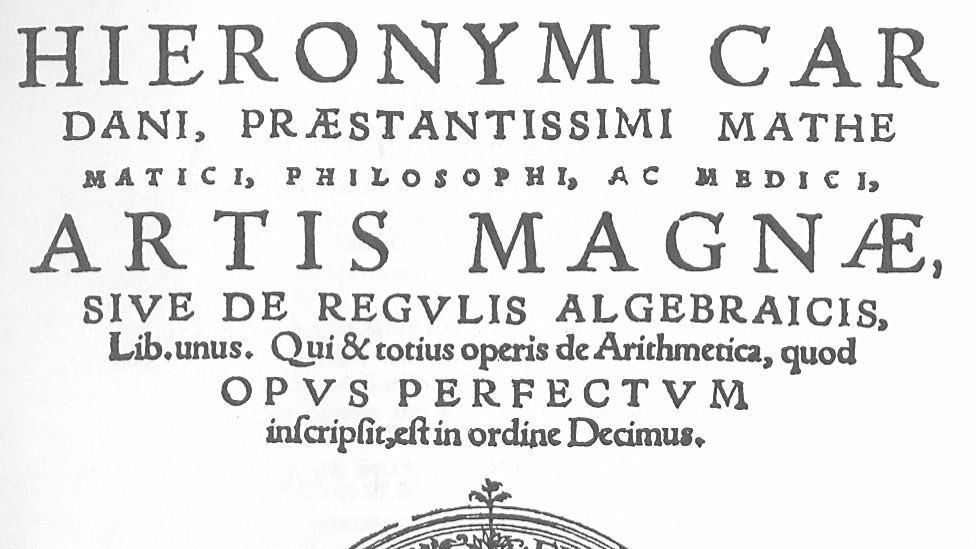
In that year they travelled to Bologna and asked della Nave to show them del Ferro's papers. There, in del Ferro's own hand, was the method, dated years before Tartaglia had found it. Cardano decided that the oath bound him to Tartaglia's discovery but not to del Ferro's, and in 1545 he published everything in Nuremberg under the title Artis Magnae, sive de Regulis Algebraicis, the Great Art. The book credits del Ferro with the first discovery and Tartaglia with the second, by name, on the first pages. That did not help. Tartaglia published his side of the story the next year, and in 1548 Ferrari, acting for Cardano, met Tartaglia in a public contest in Milan and won. Tartaglia left before the second day and lost his lecturing position in Brescia over it.
The formula
Here is what the poem says, in modern notation. To solve \(x^3 + px = q\), find two numbers \(u\) and \(v\) whose difference is \(q\) and whose product is \((p/3)^3\). Then \(x\) is the cube root of \(u\) minus the cube root of \(v\). The two numbers come from a quadratic, since their difference and product are known, and the result is
\[ x = \sqrt[3]{\frac{q}{2} + \sqrt{\frac{q^2}{4} + \frac{p^3}{27}}} \;-\; \sqrt[3]{-\frac{q}{2} + \sqrt{\frac{q^2}{4} + \frac{p^3}{27}}}. \]Why it works takes three lines. Write \(x = a - b\). Then \(x^3 = a^3 - b^3 - 3ab(a - b) = a^3 - b^3 - 3abx\), so \(x^3 + 3ab\,x = a^3 - b^3\). Matching with \(x^3 + px = q\) means choosing \(3ab = p\) and \(a^3 - b^3 = q\), and \(u = a^3\), \(v = b^3\) are the two numbers of the poem. Unit 2 of the masterclass derives this with the reader and then applies it, which is where the surprises start.
The example from the Ars Magna
Cardano's first example is \(x^3 + 6x = 20\), so \(p = 6\) and \(q = 20\). Then \(q/2 = 10\), \(q^2/4 = 100\), \(p^3/27 = 8\), and the square root is \(\sqrt{108}\), which is \(6\sqrt{3}\). The formula gives
\[ x = \sqrt[3]{10 + \sqrt{108}} - \sqrt[3]{\sqrt{108} - 10}. \]That is correct and looks nothing like the answer, which is 2: the equation says \(8 + 12 = 20\). The two cube roots are about 2.7320 and 0.7320, and they differ by exactly 2, since \(10 + \sqrt{108} = (1 + \sqrt{3})^3\) and \(\sqrt{108} - 10 = (\sqrt{3} - 1)^3\), as a patient reader can check by expanding. Cardano knew that the root was 2 and gave the formula anyway, to show that it produced the right number. The fact that a formula can be right and useless at the same time was new in 1545 and has not aged.
A worse surprise waits in the case "a cube equals things and a number", \(x^3 = px + q\). There the sign under the square root changes, and for equations such as \(x^3 = 15x + 4\), whose root 4 anyone can see, the formula asks for \(\sqrt{-121}\). Cardano noticed, called such cases "as subtle as they are useless", and moved on. Rafael Bombelli did not move on, and what he made of \(\sqrt{-121}\) in 1572 is the subject of the next article.
What the book changed
The Ars Magna is a hard read. It treats thirteen kinds of cubic separately, because negative coefficients were still not admitted, and it writes everything in words and abbreviations. Its effect was large anyway. For the first time since antiquity, mathematicians had gone past the Greeks and the Arabs on a central problem, and the method was transparently algebraic: no geometry, no conic sections, a substitution and a quadratic. Degree 4 fell at the same moment, in Ferrari's pages of the same book. The obvious next question, a formula for degree 5, occupied the best algebraists for the next 280 years, and the answer, when Abel and Galois found it, was that there is none. The reasons are in a later article and in Units 8 and 15 of the curriculum.
As for the oath, historians have been arguing about it since 1546. Cardano's defence was that the method was del Ferro's and thirty years old; Tartaglia's was that a promise is a promise. The MacTutor biography of Tartaglia gives the documents. What the formula is called tells you who won: every textbook calls it Cardano's formula, and the man who found it first, del Ferro, is remembered mostly for having kept it to himself.