 Image: Raffaele Bombelli (public domain)
The square root of minus one, forced on us by a cubic
Students are usually told that complex numbers were introduced so that \(x^2 + 1 = 0\) would have a solution. The history says otherwise. For two thousand years an equation with no real solution was simply an equation with no solution, and nobody lost sleep over it; \(x^2 + 1 = 0\) asks for a square with negative area, and there is no such square. What forced the issue was an equation that visibly did have solutions, three of them, all real, and a formula that could only reach them by passing through the square root of a negative number.
Cardano's awkward case
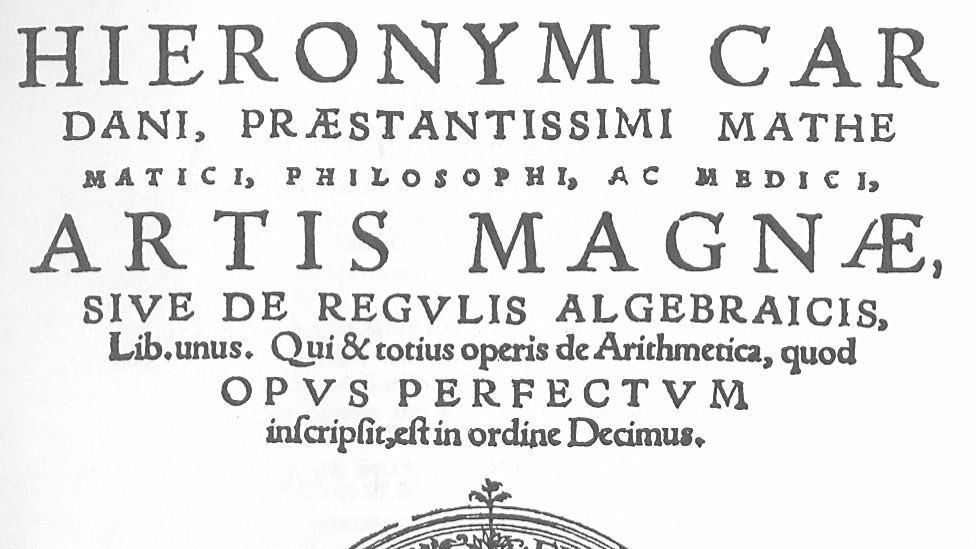
The formula for the cubic, printed in Cardano's Ars Magna in 1545, works beautifully on \(x^3 + 6x = 20\), as the previous article showed. Apply it to \(x^3 = 15x + 4\), and something goes wrong. The equation plainly has the root 4, since \(64 = 60 + 4\), and dividing out \(x - 4\) leaves \(x^2 + 4x + 1\), whose roots \(-2 \pm \sqrt{3}\) are also real. The formula, written for this shape as
\[ x = \sqrt[3]{\frac{q}{2} + \sqrt{\frac{q^2}{4} - \frac{p^3}{27}}} + \sqrt[3]{\frac{q}{2} - \sqrt{\frac{q^2}{4} - \frac{p^3}{27}}} \]with \(p = 15\) and \(q = 4\), needs \(\sqrt{4 - 125} = \sqrt{-121}\). Cardano saw this, declared such cases useless, and left them. What makes the case unavoidable is a fact proved only in the nineteenth century: whenever a cubic with rational coefficients has three distinct real roots and no rational one, every formula in square and cube roots for those roots must involve the square root of a negative number somewhere. The case is called the casus irreducibilis, and it is a theorem, not an accident of one bad choice of formula. The real roots are there; the real numbers alone cannot write them down with radicals.
Bombelli's wild thought
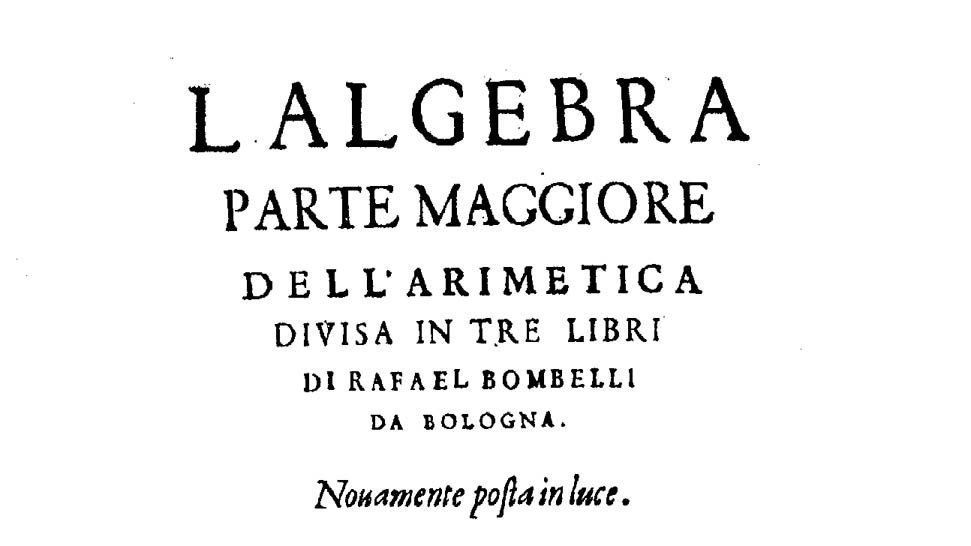
Rafael Bombelli (1526-1572) was an engineer who drained marshes for a living and wrote his Algebra during an interruption in the works. He printed it in Bologna in 1572, the year he died. In it he took Cardano's useless case seriously. Suppose, he said, that \(\sqrt{-121}\) behaves like an ordinary number as far as the rules of arithmetic go, with the one extra rule that its square is \(-121\). He invented names for the two new signs: più di meno, plus of minus, for what we write \(+i\), and meno di meno for \(-i\), and he wrote out their multiplication table in words: plus of minus times plus of minus makes minus, minus of minus times minus of minus makes minus, plus of minus times minus of minus makes plus.
Then he guessed that the cube root of \(2 + \sqrt{-121}\), which is \(2 + 11\sqrt{-1}\), might be of the form \(a + b\sqrt{-1}\) with small whole numbers \(a\) and \(b\), and he tried \(2 + \sqrt{-1}\). The check is a few lines of expansion:
\[ (2 + \sqrt{-1})^3 = 8 + 12\sqrt{-1} + 6(\sqrt{-1})^2 + (\sqrt{-1})^3 = 8 + 12\sqrt{-1} - 6 - \sqrt{-1} = 2 + 11\sqrt{-1}. \]So \(\sqrt[3]{2 + \sqrt{-121}} = 2 + \sqrt{-1}\), and by the same calculation \(\sqrt[3]{2 - \sqrt{-121}} = 2 - \sqrt{-1}\). Cardano's formula adds the two cube roots, the square roots of \(-1\) cancel, and what is left is \(2 + 2 = 4\). The formula had been right all along. It had taken the long way round, through numbers that nobody believed in, and arrived at the integer 4.
Bombelli himself called the idea "a wild thought", and he did not claim to understand what the new quantities were. He claimed only that calculating with them by fixed rules gave correct answers, and he gave enough examples to make the point stick. That is the sense in which complex numbers were accepted: as a method that worked, two centuries before anyone could say what they were.
Two hundred years of embarrassment
The name did not help. Descartes, in 1637, called roots of this kind "imaginary", meaning that one could imagine them but not exhibit them, and the word stuck as a term of mild abuse. Leibniz described \(\sqrt{-1}\) as an amphibian between being and not being. Euler used the numbers constantly and with total confidence, introduced the letter \(i\) for \(\sqrt{-1}\) in 1777, and found the formula \(e^{i\theta} = \cos\theta + i\sin\theta\) that ties them to rotation, and even he wrote sentences about them that no modern textbook would print.
What settled the matter was a picture. Caspar Wessel, a Norwegian surveyor, published in 1799 the idea of drawing \(a + bi\) as the point \((a, b)\) in the plane, so that adding complex numbers is adding arrows and multiplying by \(i\) is a quarter turn anticlockwise. Hardly anyone read it. Jean-Robert Argand printed the same idea in 1806, and Gauss used it, named the numbers "complex" in 1831, and lent them his authority. Once \(a + bi\) is a point in a plane, there is nothing imaginary about it. The square root of \(-1\) is the point one step up from the origin, and squaring it means turning twice by a right angle, which lands on \(-1\). A square with negative area was never needed.
What the numbers are
The clean definition, which Unit 3 of the masterclass gives on its first pages, does away with square roots entirely. A complex number is a pair \((a, b)\) of real numbers. Pairs are added coordinate by coordinate, and multiplied by the rule \((a, b)(c, d) = (ac - bd, ad + bc)\). One checks, in a page of routine algebra, that the familiar laws hold: addition and multiplication are commutative and associative, multiplication distributes over addition, every pair other than \((0, 0)\) has a reciprocal. The pair \((0, 1)\) squares to \((-1, 0)\), and if we agree to write \((a, 0)\) as \(a\) and \((0, 1)\) as \(i\), then \((a, b) = a + bi\) and \(i^2 = -1\) are consequences of the rule, not assumptions. Bombelli's multiplication table in words is this rule.
What the definition buys is the fundamental theorem of algebra: every polynomial equation of degree \(n\) with complex coefficients has exactly \(n\) complex roots, counted with multiplicity. The system that was invented to reach the real roots of one cubic turned out to be the system in which every polynomial equation whatever can be solved. Gauss gave the first widely accepted proof in his doctoral thesis of 1799, and the theorem is the reason why, from Unit 3 onwards, polynomials in this masterclass are factorized over the complex numbers as a matter of routine.
Back to the cubic
There is a last twist. In the casus irreducibilis the three real roots can be written without any complex numbers if one allows the cosine. François Viète showed in 1591 that for \(x^3 = px + q\) with three real roots, \(x = 2\sqrt{p/3}\,\cos\theta\) where \(3\theta\) is an angle whose cosine is known from \(p\) and \(q\). The three roots come from the three angles \(\theta\), \(\theta + 120°\), and \(\theta + 240°\), which is exactly the geometry of cube roots in the complex plane in disguise: the three cube roots of a complex number sit at 120 degrees from one another. For \(x^3 = 15x + 4\) the three angles give \(4\), \(-2 + \sqrt{3}\), and \(-2 - \sqrt{3}\), and the square root of \(-121\) never shows its face. It is still there. It is why there are three roots at 120 degrees in the first place.
Unit 3 works Bombelli's example in full as its opening calculation, then builds the complex plane, the polar form, de Moivre's formula, and the \(n\)-th roots of unity, which are needed in every later unit on equations. The MacTutor biography of Bombelli has more on the marshes, the manuscript of Diophantus he found in the Vatican, and the book he did not live to see sold.