 Image: Zéphirin Belliard (CC BY 4.0)
Lagrange's theorem in one picture
Here is a fact you can check on the symmetries of a square. The group has 8 elements. Its subgroups, the subsets that are groups in their own right, have 1, 2, 4, or 8 elements, never 3, 5, 6, or 7. The symmetries of a triangle form a group of 6 elements, and its subgroups have 1, 2, 3, or 6 elements, never 4 or 5. The pattern is general: in any finite group, the number of elements of a subgroup divides the number of elements of the group. This is Lagrange's theorem, and the proof is a single picture.
The tiles
Let \(G\) be a finite group and \(H\) a subgroup. Pick any element \(g\) of \(G\) and multiply every element of \(H\) by it on the left. The result, written \(gH\), is a set of elements of \(G\) called a left coset of \(H\). For example, in the symmetries of the square, let \(H\) be the two-element subgroup \(\{e, s\}\) containing the identity and one reflection. Multiplying by the quarter turn \(r\) gives the coset \(rH = \{r, rs\}\), which consists of the quarter turn and a diagonal reflection.
Three things are true of cosets, and each takes two lines to prove. First, every coset has exactly as many elements as \(H\), because the map sending \(h\) to \(gh\) can be undone by multiplying by \(g^{-1}\), so it never sends two elements of \(H\) to the same place. Second, every element of \(G\) lies in some coset, namely \(g\) lies in \(gH\), since \(e\) is in \(H\). Third, two cosets are either identical or disjoint: if \(gH\) and \(g'H\) share an element, then \(gh_1 = g'h_2\) for some \(h_1, h_2\) in \(H\), so \(g' = gh_1h_2^{-1}\) is \(g\) times an element of \(H\), and then \(g'H = gH\) because \(H\) absorbs multiplication by its own elements.
Now draw the group as a floor and the cosets as tiles. The tiles all have the same size, \(|H|\). They do not overlap. Together they cover the floor. So the area of the floor, \(|G|\), is the area of one tile times the number of tiles:
\[ |G| = |H| \cdot (\text{number of cosets}). \]In particular \(|H|\) divides \(|G|\). That is the whole proof. The number of tiles is called the index of \(H\) in \(G\) and written \([G:H]\). For the square with \(H = \{e, s\}\), the four tiles are \(\{e, s\}\), \(\{r, rs\}\), \(\{r^2, r^2s\}\), and \(\{r^3, r^3s\}\), and \(8 = 2 \times 4\).
Whose theorem
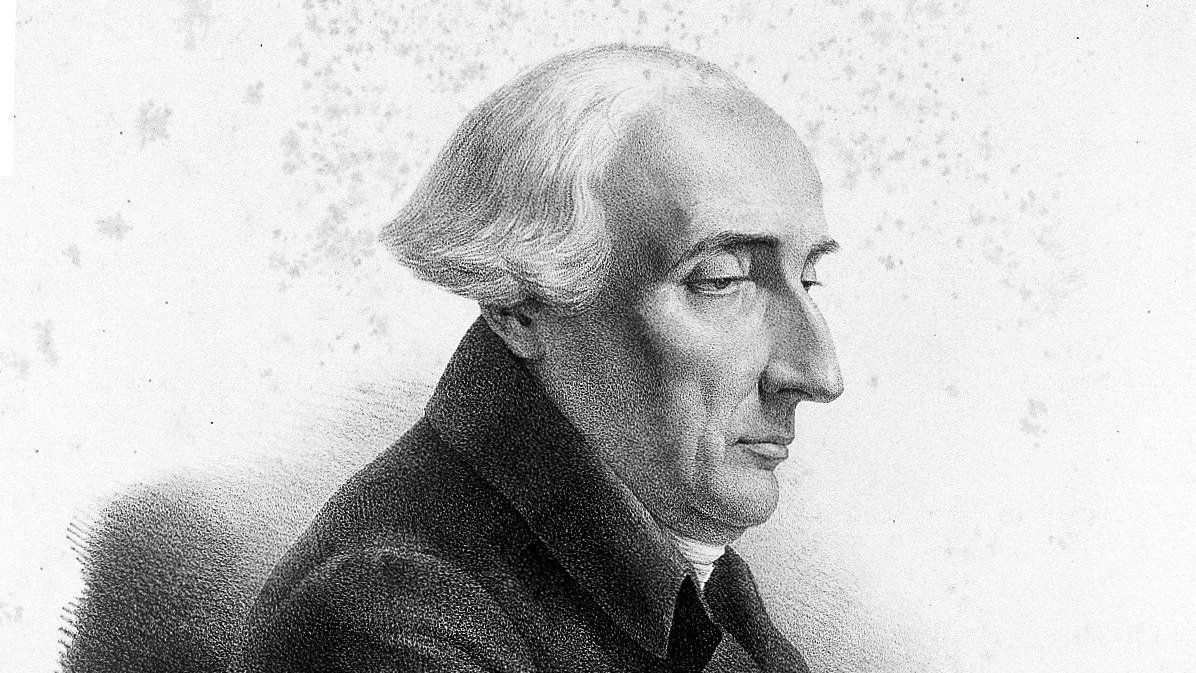
Joseph-Louis Lagrange (1736-1813) never saw a group. In his Réflexions sur la résolution algébrique des équations of 1770 to 1771 he studied what happens to an expression in the roots of a polynomial when the roots are permuted, and he proved that the number of distinct values such an expression can take always divides \(n!\), the number of permutations of \(n\) roots. That is Lagrange's theorem for the subgroup of permutations that leave the expression unchanged, in a language that had no word for subgroup. The general statement for abstract groups came with the abstract definition of a group, in the second half of the nineteenth century, and Camille Jordan's treatise of 1870 states it in a form a modern reader would recognize. The name stayed with Lagrange, which is fair, since the counting idea is his. The MacTutor biography has the rest of a long and productive life, from Turin to Berlin to Paris.
What follows at once
The theorem looks modest and does a great deal of work. Every element \(g\) of a finite group generates a subgroup \(\{e, g, g^2, \ldots\}\) whose size is the order of \(g\), the smallest positive \(k\) with \(g^k = e\). Lagrange's theorem says that this order divides \(|G|\). Hence \(g^{|G|} = e\) for every element of every finite group, which is a remarkable thing to know about an object defined by four axioms.
Apply that to the group of non-zero remainders modulo a prime \(p\) under multiplication. It has \(p - 1\) elements, so \(a^{p-1} \equiv 1 \pmod p\) for every \(a\) not divisible by \(p\). This is Fermat's little theorem, proved by Fermat in 1640 and by Euler in 1736 by other means, and here it is a three-line corollary of a picture of tiles. The same corollary applied to the invertible remainders modulo any \(n\) gives Euler's theorem, which is the fact that makes RSA encryption decrypt correctly.
A second consequence: if \(|G|\) is a prime \(p\), then the only subgroups have size 1 or \(p\), so any element other than \(e\) generates the whole group. Every group of prime order is cyclic, and there is exactly one group of each prime order. A third: a group of order 6 cannot contain an element of order 4, a group of order 8 cannot contain one of order 3, and so on, which cuts down the search when one tries to list all groups of a given small order, as Unit 9 does for orders up to 8.
What does not follow
The converse is false. Lagrange's theorem says that subgroup sizes are divisors of \(|G|\); it does not say that every divisor is the size of some subgroup. The standard counterexample is the group \(A_4\) of even permutations of four objects, which is also the rotation group of a regular tetrahedron. It has 12 elements, and 6 divides 12, and \(A_4\) has no subgroup with 6 elements. The proof is a short count: \(A_4\) contains eight 3-cycles, a subgroup of order 6 would have index 2 and therefore contain the square of every element of \(A_4\), and the square of a 3-cycle is again a 3-cycle, so all eight 3-cycles would have to fit in a subgroup of 6 elements. They do not.
Partial converses exist and are deep. Cauchy proved in 1845 that if a prime \(p\) divides \(|G|\) then \(G\) has an element, and so a subgroup, of order \(p\). Ludwig Sylow proved in 1872 that if \(p^k\) is the largest power of \(p\) dividing \(|G|\) then there is a subgroup of order \(p^k\), together with precise information on how many such subgroups there are. The Sylow theorems are the main tool for proving that a group of a given order cannot be simple, and the masterclass uses them in Unit 15 on the way to the quintic.
Left, right, and normal
The picture was drawn with left cosets \(gH\). Right cosets \(Hg\) tile the group just as well, and the tiles have the same size, so the count is the same. The two tilings need not coincide. In the symmetries of the square with \(H = \{e, s\}\), the left coset \(rH = \{r, rs\}\) and the right coset \(Hr = \{r, sr\}\) differ, because \(rs\) and \(sr\) are different reflections. Subgroups for which the two tilings agree are called normal, and they are the ones for which the tiles themselves can be multiplied to form a new, smaller group, the quotient. That construction is the second half of Unit 9 and the entrance to everything Galois did. The picture of tiles is where it begins, and it is a picture worth drawing by hand at least once, on the square, with all eight symmetries written in. The curriculum says where Unit 9 sits among the sixteen.