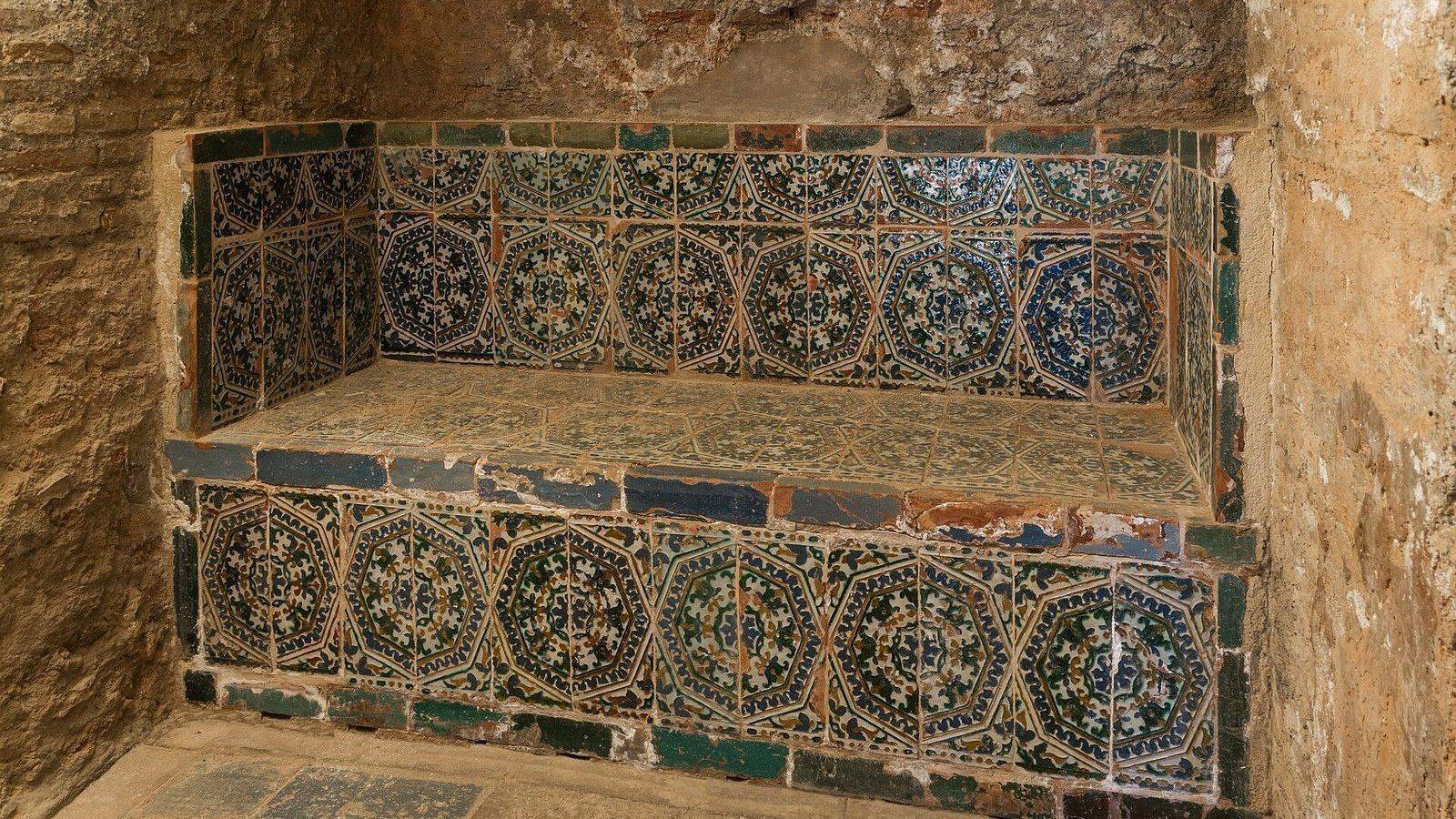
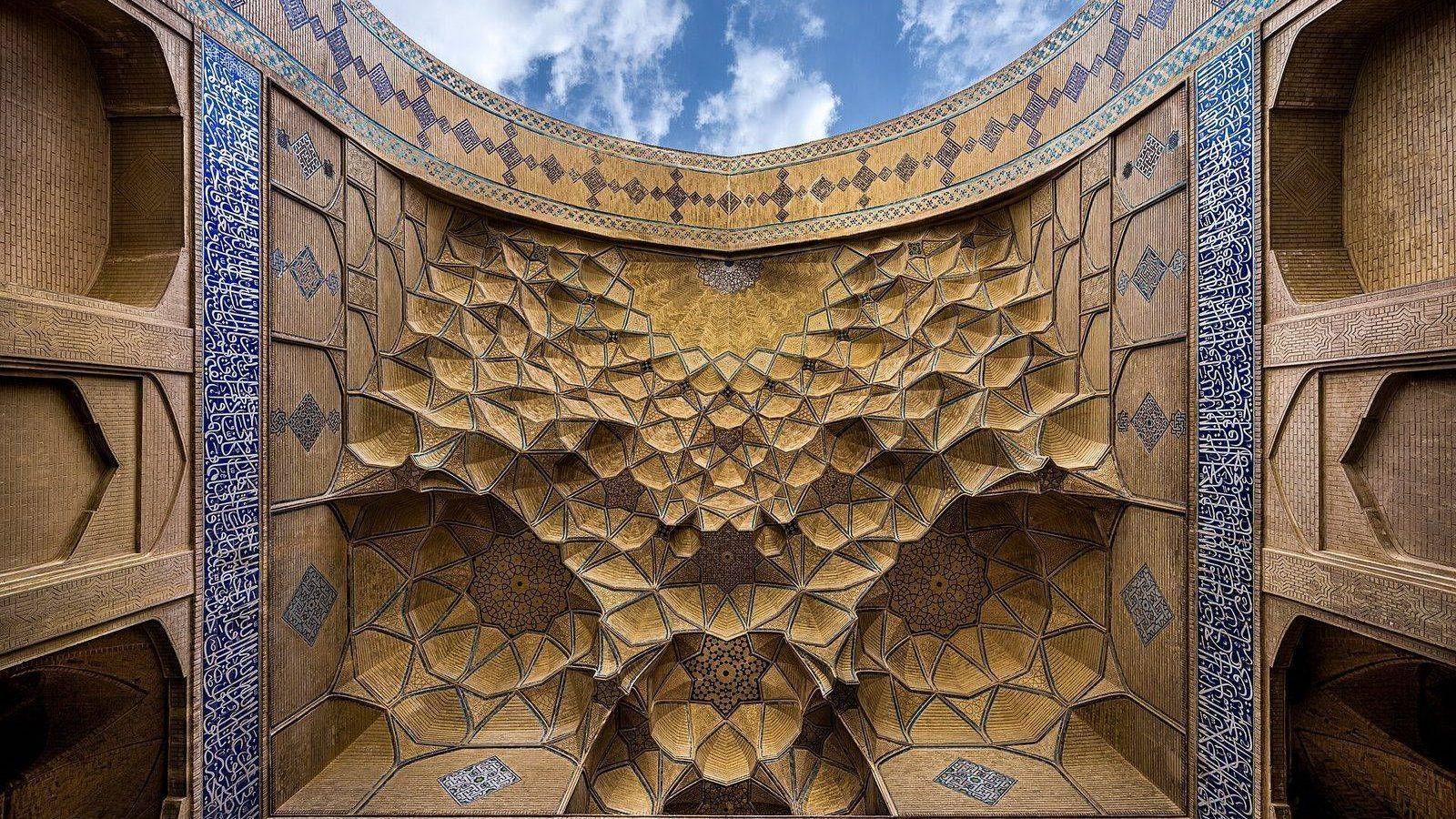
 Image: Amir Pashaei (CC BY-SA 4.0)
The eight symmetries of a square
Take a square piece of card, draw its outline on the table, and number the corners 1 to 4 anticlockwise, starting at the top right. Pick the card up, do something to it, and put it back inside the outline. How many different results are there? The question sounds like a puzzle for a rainy afternoon, and its answer, eight, together with the table of how those eight combine, is the first group that most people meet, whether in a school club, a first university year, or Unit 5 of this masterclass.
Finding the eight
Corner 1 must land on one of the four corners of the outline, and once it has, the card is either the right way up or flipped over. Four choices times two gives eight, and every one of the eight can be done. Four of them keep the card face up: leaving it alone, which we call \(e\); turning it anticlockwise by a quarter turn, \(r\); by a half turn, \(r^2\); and by three quarters, \(r^3\). The other four flip the card over: the reflection in the horizontal axis, \(s\), and the reflections in the vertical axis and in the two diagonals. Written as what happens to the corners, \(r\) sends corner 1 to where corner 2 was, 2 to 3, 3 to 4, and 4 to 1, while \(s\) swaps 1 with 4 and 2 with 3.
A ninth symmetry does not exist, because a symmetry is determined by where it puts the corners, the corners must go to corners, and neighbours must stay neighbours. That rules out the \(24 - 8 = 16\) other rearrangements of four corners, such as swapping only 1 and 2.
Combining two of them
Do one symmetry and then another, and the result is again one of the eight. The convention in this masterclass, and in most books, is to write the composite \(ab\) for "first \(b\), then \(a\)", as with functions. So \(rs\) means reflect first, then turn. Follow corner 1: the reflection \(s\) sends it to position 4, and the quarter turn sends position 4 to position 1, so corner 1 ends up where it started. Corner 2 goes to position 3 under \(s\) and then to position 4. Both corners on the right edge went where they were, swapped on the left edge, so \(rs\) is the reflection in the diagonal through corners 1 and 3.
Now do them in the other order. Under \(sr\), corner 1 first turns to position 2, then reflects to position 3. That is the reflection in the other diagonal. So \(rs\) and \(sr\) are different symmetries. This is the single most important fact in the table: the order in which you do things matters. School arithmetic never prepares anyone for it, since \(3 \times 5\) and \(5 \times 3\) agree, and most of the surprises of group theory trace back to this one failure.
The full table of composites has 64 entries. Filling it in takes an hour of corner-chasing, which is exactly how Unit 5 asks its readers to spend part of their first week with groups, and the table that results has a name, the Cayley table of the group, after Arthur Cayley, who in 1854 was the first to define a group by such a table rather than by what its elements did. The two entries at the positions \((r, s)\) and \((s, r)\) are the ones that show the table is not symmetric about its diagonal.
What makes it a group
Four properties of the table are the ones that count. First, every composite of two symmetries is one of the eight, so the table never needs a ninth symbol. Second, composing is associative: \((ab)c = a(bc)\), which holds automatically because the symmetries are functions and composition of functions is always associative. Third, there is a do-nothing symmetry \(e\) with \(ea = ae = a\) for every \(a\). Fourth, every symmetry can be undone: \(r^3\) undoes \(r\), and every reflection undoes itself. A set with an operation obeying these four rules is a group, and once you have the definition you can forget the cardboard.
The square's group is called the dihedral group of order 8 and written \(D_4\) in this masterclass, the 4 counting the sides of the polygon; some books write \(D_8\), counting the elements, which is a standing source of confusion in the literature and worth knowing about before you read further. The same construction for a regular \(n\)-gon gives \(D_n\) with \(2n\) elements: \(n\) rotations and \(n\) reflections. For a triangle that is 6, and the triangle's group turns out to be the same as the group of all rearrangements of three objects.
Reading the table
A few facts jump out of the finished table. Every element has an order, the number of times you must apply it before you are back at \(e\): the rotation \(r\) has order 4, the half turn \(r^2\) has order 2, and each of the four reflections has order 2, so \(D_4\) has five elements of order 2, two of order 4, and one of order 1. The half turn \(r^2\) commutes with everything, and it is the only element besides \(e\) that does; the set \(\{e, r^2\}\) is called the centre of the group.
Inside the table sit smaller tables that are groups in their own right. The four rotations form one, and so does any reflection together with \(e\). In all, \(D_4\) has ten of these subgroups, of sizes 1, 2, 4, and 8, and no subgroup has 3 or 5 or 6 elements. That the size of a subgroup must divide the size of the group is Lagrange's theorem, the subject of a later article and of Unit 9, and the square is the place where most people first see it happen. The catalogue page for \(D_4\) on GroupNames draws the ten subgroups as a lattice and lists everything else about the group that anyone has ever asked.
Why a square
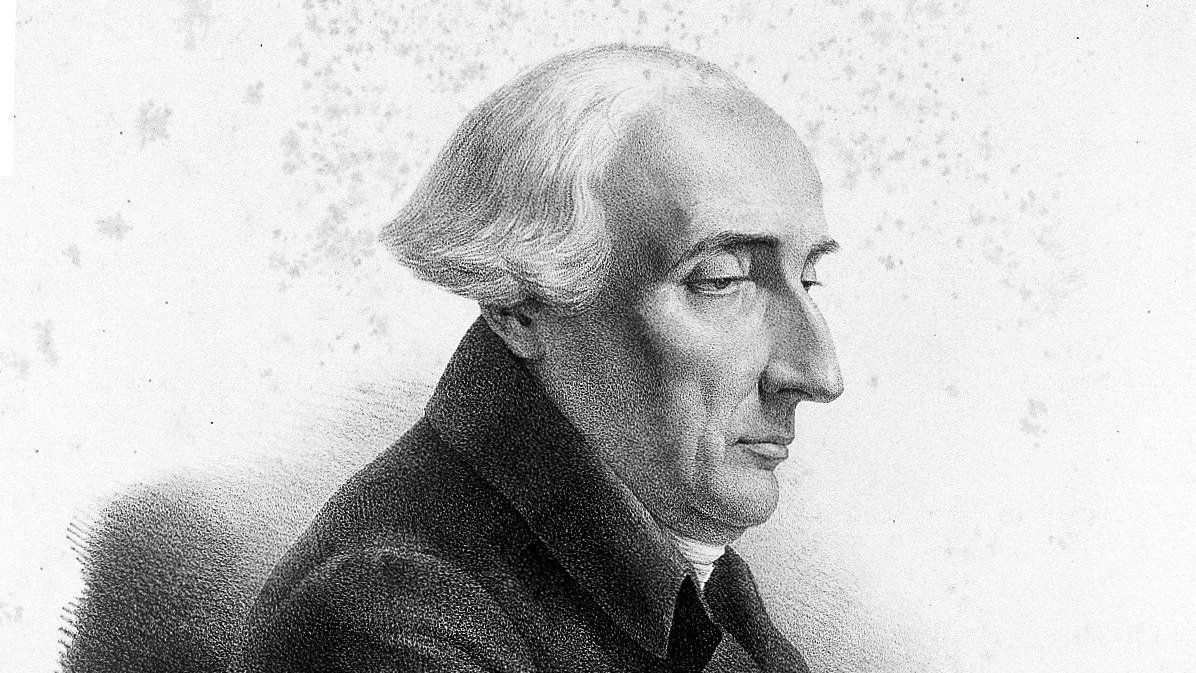
Groups did not begin with squares. They began with Lagrange and Galois asking what happens to the roots of an equation when you rearrange them, and with the symmetries of crystals, and the abstract definition came last. The square is used to teach them because it is the smallest example in which everything interesting happens at once: an operation that is not commutative, elements of different orders, a centre that is more than \(e\), subgroups of every size that the theory allows and none that it forbids. The cyclic groups, such as the six rotations of a hexagon, are too well behaved to show any of this, and the rearrangements of four objects, with 24 elements, are already too many to write out comfortably.
There is also the fact that the square's symmetries are visibly real. The vault of the Jameh Mosque in Isfahan in the photograph above, with its four-fold pattern, has the symmetry group \(D_4\) in the same sense that the piece of card does; so does a chessboard without its pieces, and so does the cross-section of a square beam, which is why engineers meet this group when they compute how the beam vibrates. Unit 5 of the masterclass builds the Cayley table of \(D_4\) with the reader and then shows how the four rules extracted from it describe the integers under addition, the non-zero fractions under multiplication, the invertible matrices, and the roots of unity, none of which has anything to do with cardboard. The curriculum lists what follows.