 Image: Jebulon (CC0)
The 17 wallpaper groups
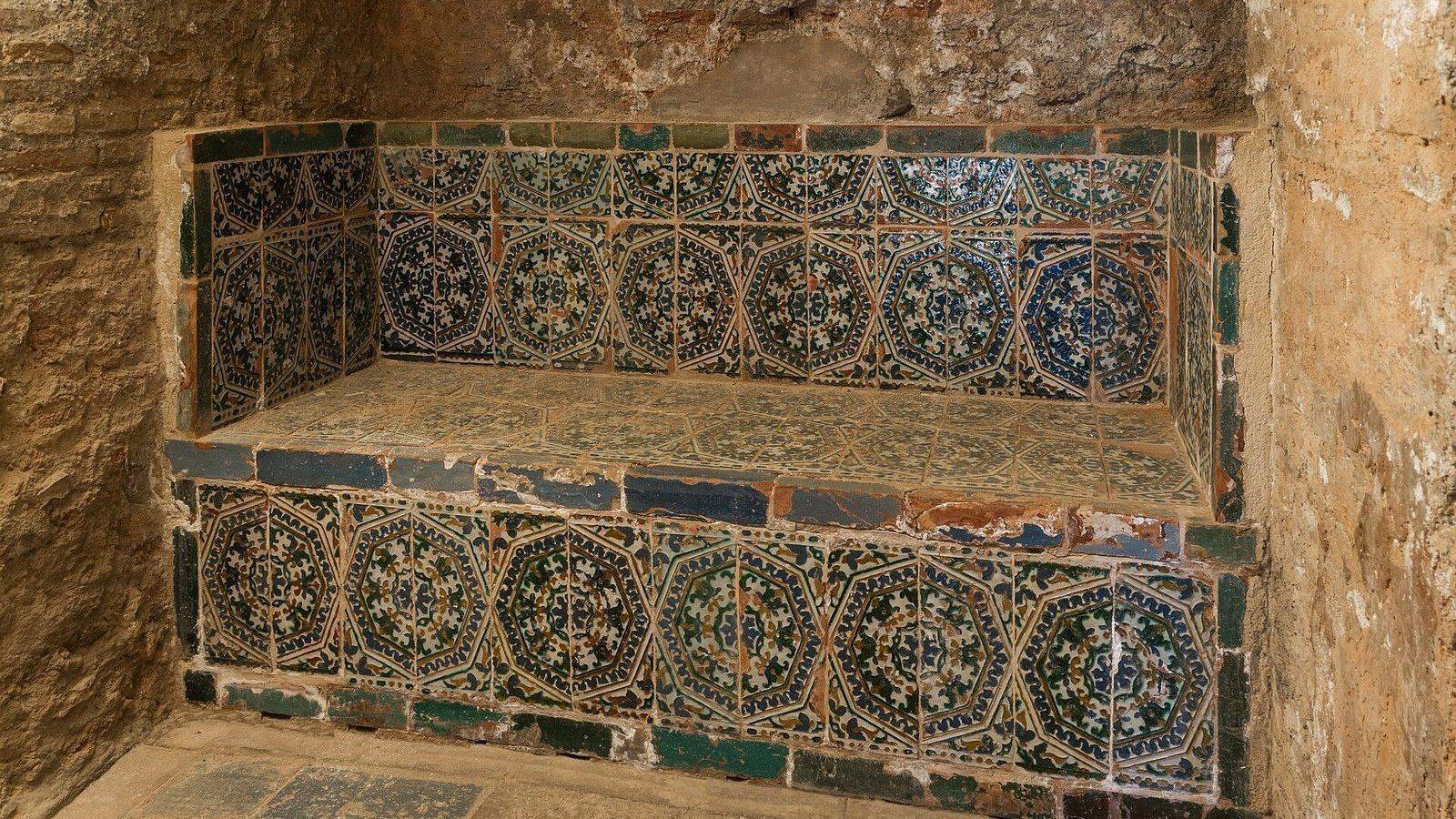
Look at the tiled bench in the photograph above, from the baths of the Nasrid palace at the Alhambra in Granada, and ask what you can do to the pattern without changing it. You can slide it along by the width of one tile, in two directions. You can turn the pattern about certain points, by a quarter turn or a half turn, depending on where you put the pin. You can reflect it in certain lines. The set of all these motions is a group, in the sense of Unit 5, and the striking fact is that for patterns that repeat in two directions only 17 such groups exist. Every wallpaper, floor tiling, printed fabric, and brick wall in the world has one of the 17.
What counts as a wallpaper pattern
A wallpaper pattern is a design in the plane that repeats in two independent directions, so that there are two translations, in different directions, that carry the pattern onto itself, and the pattern does not repeat at arbitrarily small scales. The set of all translations that preserve it forms a lattice, a grid of points like the corners of a sheet of graph paper, though the grid may be slanted or made of rhombi. The symmetry group of the pattern consists of every rigid motion of the plane, translation, rotation, reflection, or glide reflection, that carries the pattern onto itself. Two patterns have the same wallpaper group when their symmetries match up, regardless of what the motif looks like.
Why five-fold rotation is impossible
The first thing to prove is that a wallpaper pattern can have rotational symmetry of order 1, 2, 3, 4, or 6 only, and never 5 or anything above 6. This is called the crystallographic restriction, and the argument takes a paragraph.
Suppose the pattern has a rotation by the angle \(\theta = 360°/n\) about some point \(P\). Rotating the whole lattice of translations about \(P\) gives another set of translations that preserve the pattern, so the lattice is carried onto itself. Now take a translation of the lattice of the shortest possible length, say by the vector \(\mathbf{v}\). The rotated vector \(R\mathbf{v}\) is also in the lattice, and so is \(R\mathbf{v} + R^{-1}\mathbf{v}\), which is a vector parallel to \(\mathbf{v}\) of length \(2\cos\theta\,|\mathbf{v}|\). Since every lattice vector parallel to \(\mathbf{v}\) is a whole-number multiple of \(\mathbf{v}\), the number \(2\cos\theta\) must be an integer. Its only possible values are \(-2, -1, 0, 1, 2\), which correspond to \(\theta = 180°, 120°, 90°, 60°, 0°\), that is, to \(n = 2, 3, 4, 6, 1\). For a pentagon, \(2\cos 72° = 0.618\ldots\), which is not an integer, and five-fold symmetry is ruled out. The same argument with matrices says that the trace of a rotation matrix with integer entries is an integer, which is how Unit 11 phrases it.
This is why there are no pentagonal tilings of the kind the Nasrid tilers would otherwise surely have made, and why the quasicrystals discovered by Dan Shechtman in 1982, which show five-fold symmetry in their diffraction patterns, caused such a scandal that he was asked to leave his research group. Quasicrystals do not repeat; they evade the theorem by failing its hypothesis, and Shechtman received the Nobel Prize in Chemistry for them in 2011.
Counting to 17
Once the possible rotations are known, the 17 groups come from combining them with reflections and glide reflections in every way consistent with a lattice. The names in the notation used by crystallographers are p1, p2, pm, pg, cm, pmm, pmg, pgg, cmm, p4, p4m, p4g, p3, p3m1, p31m, p6, and p6m. The letter p or c describes the lattice, the digit gives the highest order of rotation, and m and g record mirrors and glides. The simplest, p1, has translations and nothing else; a pattern of identical footprints walking in one direction has it. The richest, p6m, has six-fold rotations, mirrors through them, and more, and is the group of a honeycomb. The bench in the photograph, with its squares and four-fold stars, belongs to the p4m family if the colours are ignored.
The classification was first proved by the Russian crystallographer Evgraf Fedorov in 1891, in the same work in which he classified the 230 space groups of three-dimensional crystals; Arthur Schoenflies reached the 230 independently in the same year. The two-dimensional case was then forgotten and reproved by George Pólya in 1924, in a paper that Pólya's friend Paul Niggli, a crystallographer, published next to his own derivation. Pólya's paper is the one that reached a wide audience, because a Dutch graphic artist read it.
Escher and the Alhambra
M. C. Escher visited the Alhambra in 1922 and again, for several days of copying, with his wife in 1936. He had no mathematical training and did not know the classification, but his sketchbooks from the trip show that he was systematically trying to work out what combinations of motions were possible, and in 1937 his half-brother, a geologist, gave him Pólya's paper. Escher copied all 17 diagrams by hand, worked out his own system of notation, and from then on his periodic drawings, the fish, the lizards, the angels and devils, were made with the theory consciously in hand. He wrote later that the Alhambra was the richest source of inspiration he had ever tapped.
Whether the Alhambra itself contains all 17 groups has been argued since 1944, when Edith Müller found 11 in her doctoral thesis; later authors claimed 13, then all 17, and Branko Grünbaum replied in 2006 that several of the claimed examples depend on counting colour changes as symmetries or on ignoring details of the actual tiles. What is not disputed is that the Nasrid craftsmen of the fourteenth century, without any theory, produced patterns in more of the 17 families than any other single building, and that they got there by trying every combination of a few shapes and a few rules.
The one-dimensional case and the colour case
A pattern that repeats in one direction only, like a frieze along the top of a wall or a row of footprints, has one of just 7 symmetry groups, the frieze groups, and these can be classified in an afternoon by anyone who has read Unit 5; it is a good first project after the symmetries of the square. The other direction, allowing colours to be permuted by the symmetries, gives 46 two-colour wallpaper groups, and the counts grow quickly from there.
In three dimensions the 230 space groups are what every crystal structure is filed under, and the international tables that list them are the reference work of crystallography. The theory also runs in four dimensions, where there are 4894 groups, counted by computer in 1978. In every dimension the finiteness is a theorem, proved by Ludwig Bieberbach in 1910 in answer to one of Hilbert's problems of 1900.
What the masterclass does with it
Unit 5 introduces groups through the symmetries of a square and names the wallpaper groups as the next example along, with the crystallographic restriction proved as above. Unit 10, on group actions, has the tools for counting things up to symmetry, which is the method behind the classification itself, and it returns to the Alhambra for the counting of coloured tilings with Burnside's lemma. For anyone who wants to identify the group of a pattern at home, the question sequence is short: what is the highest order of rotation, are there mirror lines, do all rotation centres lie on mirrors, and are there glide reflections that are not products of the mirrors; the answers single out one of the 17. The MacTutor biography of Pólya covers his paper and the rest of a career that included the book on how to solve problems. The curriculum says where Units 5 and 10 fall.