 Image: Muḥammad ibn Musa al-Khwarizmi (public domain)
Where the word algebra comes from
The word algebra comes from the title of a book. Muhammad ibn Musa al-Khwarizmi, a scholar at the court of the caliph al-Ma'mun in Baghdad, wrote around 820 a work whose title is usually given as al-Kitab al-mukhtasar fi hisab al-jabr wa'l-muqabala, the Compendious Book on Calculation by Completion and Balancing. The date is not known exactly; sources place it anywhere between 813 and 833. The third word from the end, al-jabr, is the one that survived. Within four centuries it had become the Latin algebra, and from Latin it passed into every European language with hardly a change of spelling.
Two moves, not a subject
Al-jabr did not mean algebra. It meant one specific operation on an equation: restoring a quantity that had been subtracted, which we would describe as moving a negative term to the other side. If a problem led to "a square less ten things equals thirty-nine", al-jabr turned it into "a square equals thirty-nine and ten things". The companion word al-muqabala, balancing, meant cancelling equal amounts of the same kind from both sides, so that "a square and five things equals three things and thirty" became "a square and two things equals thirty". After the two moves, every problem of degree at most 2 fell into one of six standard shapes, and the book gave a recipe for each.
The six shapes are worth seeing, because they show what was missing. In al-Khwarizmi's language, with "square" for \(x^2\), "root" or "thing" for \(x\), and "number" for a constant, they are: squares equal roots, squares equal numbers, roots equal numbers, squares and roots equal numbers, squares and numbers equal roots, and roots and numbers equal squares. We would write all six as \(ax^2 + bx + c = 0\) and be done. He could not, because for him every coefficient was a positive quantity and both sides of an equation had to stand for something positive. The idea that \(c\) might be negative, so that one shape covers all, needed another eight hundred years.
The same applies to the letters. The book has no \(x\), no \(=\), no \(+\). Every problem and every solution is written out in words. The notation we use, with letters from the end of the alphabet for unknowns and from the beginning for known quantities, was fixed by René Descartes in 1637, and the equals sign was proposed by Robert Recorde in 1557 on the grounds that no two things can be more equal than a pair of parallel lines.
The worked example that every reader remembers
Al-Khwarizmi's standard example of the fourth shape is "a square and ten roots equal thirty-nine", which is \(x^2 + 10x = 39\). His recipe runs: halve the number of roots, which gives 5; multiply it by itself, which gives 25; add it to 39, which gives 64; take the root, which is 8; subtract the half of the number of roots, which gives 3. The root is 3, and the square is 9.
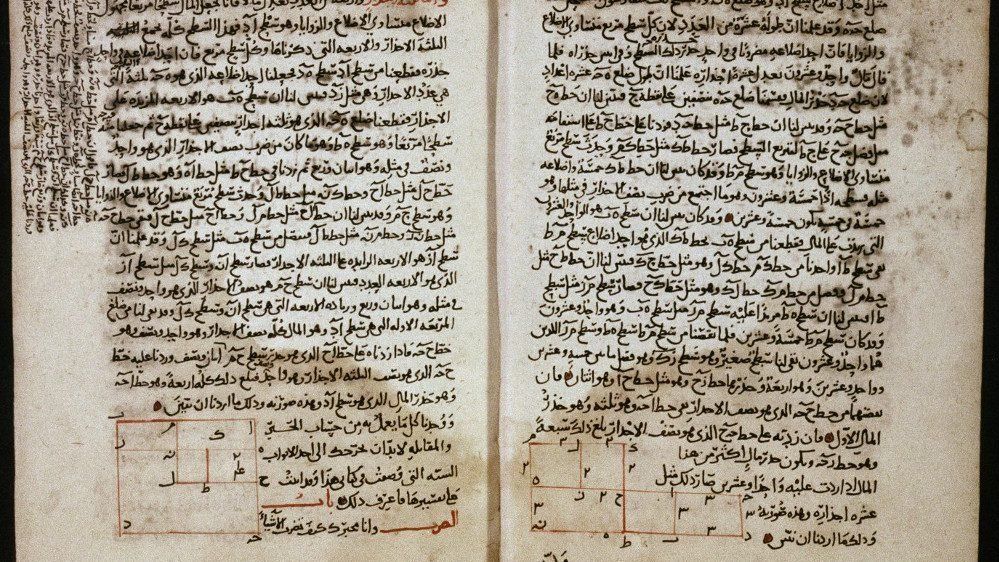
Every step of that recipe is completing the square, and he says why it works with a drawing. Draw a square of side \(x\). Attach a rectangle of sides \(x\) and 5 to one edge and another to a neighbouring edge; together with the square they have area \(x^2 + 10x\), which is 39. The figure is a larger square with one corner missing, and the missing corner is a square of side 5 and area 25. Fill it in. The completed square has area \(39 + 25 = 64\) and so has side 8, and its side is also \(x + 5\). Hence \(x = 3\). The manuscript at the top of this article, copied in the fourteenth century and now in the Bodleian Library in Oxford, shows exactly these figures in red ink.
The negative root, \(x = -13\), does not appear. There was no place for it in a world where \(x\) is the side of a square. What does appear, in the fifth shape, is the observation that an equation can have two positive roots, or one, or none, with the condition that decides between the cases: our discriminant, in words.
Why a book of recipes mattered
Nothing in the book was beyond the Babylonians, who solved the same kinds of problem on clay tablets around 1800 BC, or beyond Diophantus of Alexandria, who wrote around AD 250 and used a symbolic shorthand that al-Khwarizmi lacked. What was new was the organization. The Babylonian tablets are lists of solved problems; al-Khwarizmi starts from the general shapes, gives a general procedure for each, proves each procedure with a figure, and only then turns to applications, which take up most of the book: inheritance law, trade, surveying. The equation is the object of study, and the methods are stated once, for every instance at the same time. That is the step from arithmetic to algebra, and it is why historians date the subject from this book rather than from the tablets.
The author's name left a second trace. His other surviving book explained the Indian decimal place-value system with its nine digits and zero. In Latin translation it opened with the words Dixit Algorizmi, "al-Khwarizmi said", and the Latinized name became the word for any calculating procedure with the digits, and eventually for any mechanical procedure at all: algorithm.
From Baghdad to Toledo to the rest of Europe
The road the word took is the road the mathematics took. In the twelfth century, Toledo in Spain was the place where Arabic learning was translated into Latin, and two translators turned to the Algebra within a few years of each other. Robert of Chester finished his Liber algebrae et almucabola in Segovia in 1145, and Gerard of Cremona made another version in Toledo soon after. Leonardo of Pisa, known as Fibonacci, learned the methods from Arabic sources in North Africa and gave them a section of his Liber Abaci of 1202. For the next three centuries the Italian masters of calculation, the maestri d'abaco, taught "algebra e almucabala" to merchants' sons, and the second word slowly dropped off.
The Italian word algebra still meant the setting of broken bones well into the sixteenth century, a direct descendant of the original sense of restoring, and in Spain an algebrista was a bone-setter; Cervantes uses the word that way in Don Quixote. By then the mathematical sense had won in print. Luca Pacioli's Summa of 1494 and Cardano's Ars Magna of 1545, the book that first solved the cubic, both call the subject algebra without feeling a need to explain.
What is left of al-jabr today
A student who learns to solve a quadratic equation by completing the square is doing precisely what the book of 820 taught, picture included, and the quadratic formula is nothing other than the recipe for "squares and roots equal numbers" written with letters and extended to negative coefficients. The other operation, moving terms across the equals sign and cancelling, is the first thing anyone does with an equation and is so automatic that it has lost its name.
The deeper legacy is the habit of mind. Al-Khwarizmi treated an equation as a thing with a shape, to be sorted and solved by rule, and he insisted that each rule be justified. Unit 1 of the Algebra Masterclass begins in the same place: it draws the completed square, states the difference between an identity and an equation, and uses al-Khwarizmi's problem as its first worked example before moving on to proof. Where the subject went after that, from the cubic to the groups of Galois, is the subject of the rest of the curriculum. For the man himself, the MacTutor biography is the place to start, and it is candid about how little is known of his life beyond his books.