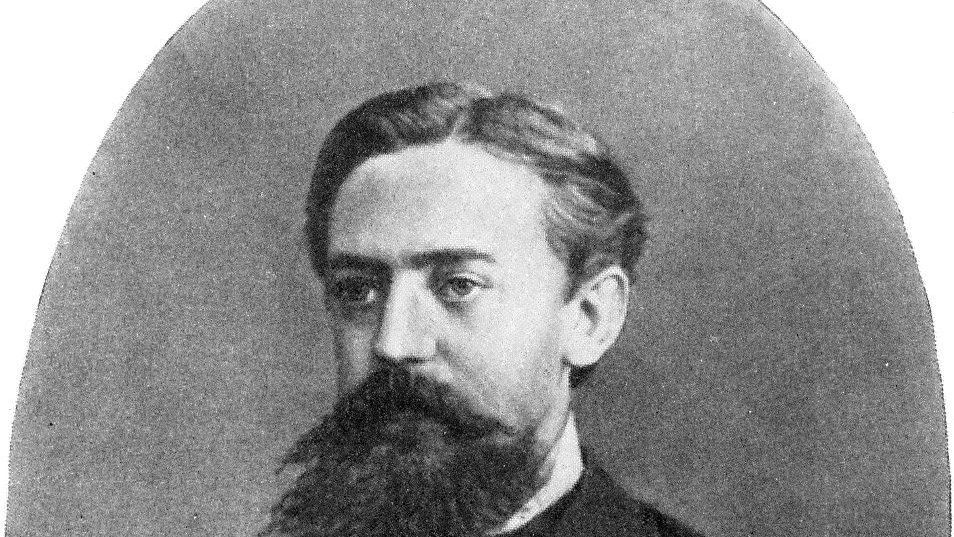
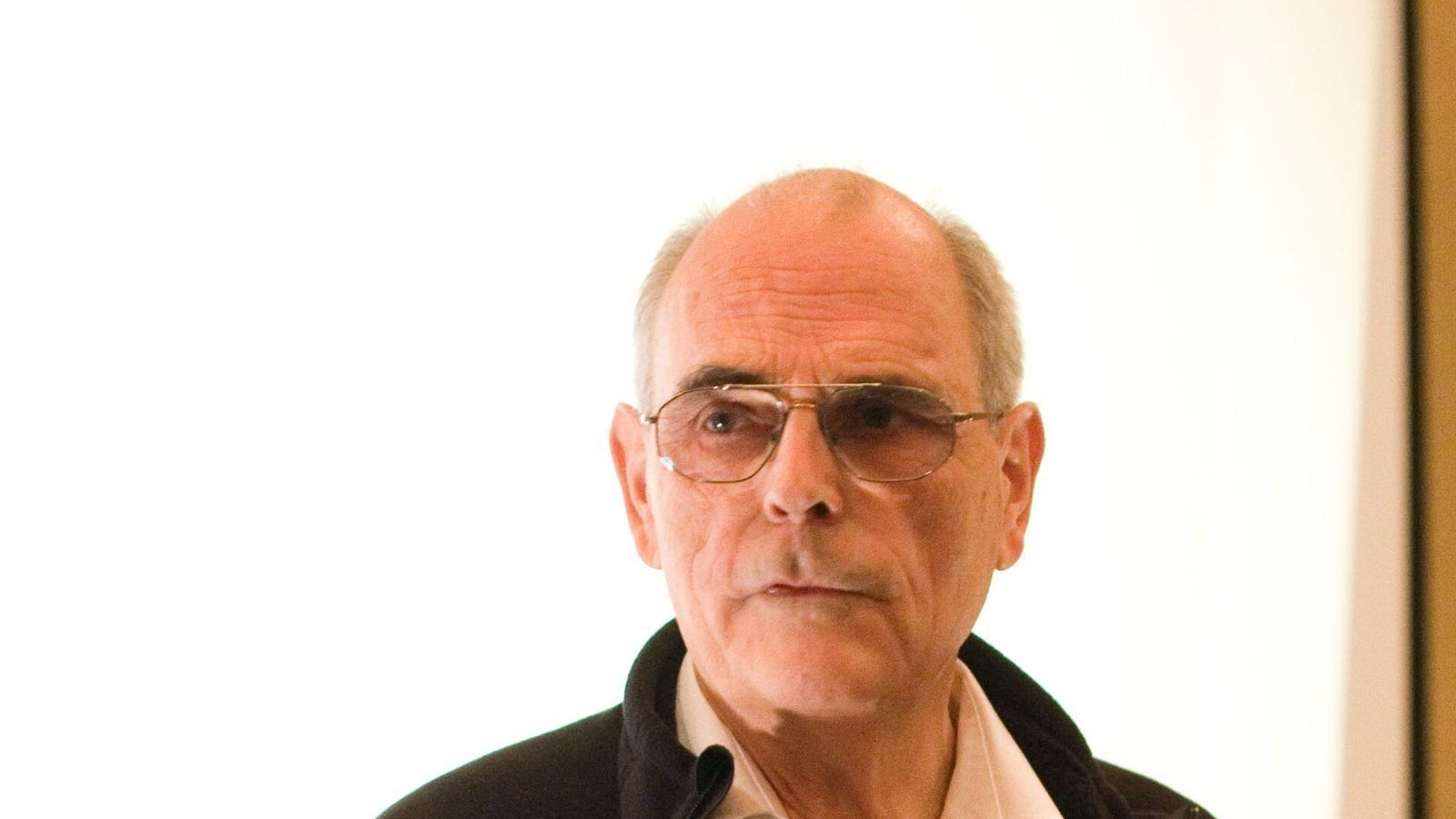
 Image: David Eppstein (CC BY-SA 3.0)
How fast can two matrices be multiplied?
To multiply two \(n\) by \(n\) matrices the way Unit 4 teaches, each of the \(n^2\) entries of the product is a sum of \(n\) products, so the whole job takes \(n^3\) multiplications and about as many additions. For \(n = 1000\) that is a billion multiplications, and matrices of that size and far larger are multiplied constantly, in weather models, in the training of neural networks, in the simulation of every structure and circuit. Until 1969 it was taken as obvious that \(n^3\) was the cost. Then Volker Strassen, trying to prove that it was, found that it was not.
Seven instead of eight
Multiplying two 2 by 2 matrices by the definition takes 8 multiplications of numbers. Strassen found a way to do it with 7, at the cost of 18 additions instead of 4. Write the two matrices as \(A\) with entries \(a, b, c, d\) and \(B\) with entries \(e, f, g, h\), in the usual reading order. Form the seven products
\[ \begin{aligned} m_1 &= (a + d)(e + h), & m_2 &= (c + d)e, & m_3 &= a(f - h), & m_4 &= d(g - e), \\ m_5 &= (a + b)h, & m_6 &= (c - a)(e + f), & m_7 &= (b - d)(g + h). \end{aligned} \]Then the four entries of \(AB\) are \(m_1 + m_4 - m_5 + m_7\), \(m_3 + m_5\), \(m_2 + m_4\), and \(m_1 - m_2 + m_3 + m_6\). Checking this is ten minutes with a pencil and is a worthwhile ten minutes, because nothing about the formulas is natural and nobody has a good story about how Strassen found them.
Saving one multiplication in eight would not matter if that were all. The point is that the seven products never use the commutative law, so the entries \(a, \ldots, h\) can themselves be matrices. A \(2n\) by \(2n\) matrix is a 2 by 2 matrix of \(n\) by \(n\) blocks, and Strassen's formulas multiply it with 7 block multiplications instead of 8. Apply the same trick to each block, and to each block of each block, and the cost of multiplying \(n\) by \(n\) matrices becomes about \(n^{\log_2 7} = n^{2.807\ldots}\) rather than \(n^3\). For \(n = 1000\) the saving is a factor of about 4; for \(n\) a million, about 15. The additions grow too, but only as \(n^2\) at each level, which does not change the exponent. Strassen's paper, Gaussian Elimination is not Optimal, is three pages long, and its title refers to the consequence that solving linear systems, inverting matrices, and computing determinants all inherit the faster exponent, since each can be reduced to matrix multiplication.
The exponent \(\omega\)
The natural question is the smallest exponent possible. Define \(\omega\) as the greatest lower bound of the numbers \(c\) such that two \(n\) by \(n\) matrices can be multiplied in at most \(n^{c}\) operations, up to a constant factor, for all large \(n\). The school method shows \(\omega \le 3\), Strassen shows \(\omega \le 2.807\), and since the product has \(n^2\) entries that must each be written down, \(\omega \ge 2\). Everything else is open.
Progress after Strassen came slowly and then in bursts. Victor Pan brought the bound below 2.8 in 1978. Don Coppersmith and Shmuel Winograd found in 1987 a method giving \(\omega < 2.376\), published in 1990, and that figure stood for twenty years. Andrew Stothers in 2010 and Virginia Vassilevska Williams in 2012 found ways to squeeze more from the Coppersmith-Winograd method, François Le Gall improved it to 2.3728639 in 2014, and Josh Alman and Vassilevska Williams reached 2.37286 in 2021. Ran Duan, Hongxun Wu, and Renfei Zhou found a new source of loss in the method in 2023 and brought the exponent to 2.371866; Vassilevska Williams, Yinzhan Xu, Zixuan Xu, and Zhou pushed it to 2.371552 for the SODA conference of 2024; and Alman, Duan, Vassilevska Williams, Xu, Xu, and Zhou reached 2.371339 for SODA 2025, which is the record as this article is written. The record moves, and the number to check before quoting it is in the most recent of those papers.
Why nobody uses the fast methods
Every algorithm since Coppersmith and Winograd is what computer scientists call galactic: the constant hidden in "up to a constant factor" is so large that the method would beat Strassen only for matrices with more entries than there are atoms in the galaxy. They are proofs that a certain exponent is achievable, not programs. Strassen's own method is different; it is used in practice, in some numerical libraries, for matrices with a few thousand rows, where it gives a real saving, though its numerical stability is slightly worse than the school method's and it is often switched off in scientific computing for that reason.
Nor is it known whether 7 multiplications can be beaten for 2 by 2 matrices in some other way. Shmuel Winograd proved in 1971 that 7 is optimal for 2 by 2, and Hopcroft and Kerr proved the same year that 7 is optimal even when commutativity may not be used. For 3 by 3 matrices the definition takes 27 multiplications, the best known method takes 23, found by Julian Laderman in 1976, and the best lower bound is 19. In 2022 a team at DeepMind trained a program called AlphaTensor to search for such formulas and found, among other things, a way to multiply two 4 by 4 matrices over the field with two elements in 47 multiplications rather than the 49 that two rounds of Strassen give, and a 96-multiplication method for 5 by 5 matrices in place of 98; the paper is in Nature. Human mathematicians answered within weeks with 95 for the 5 by 5 case. None of these change \(\omega\), which is about the limit of the exponent, but they show how little is known even for tiny matrices.
Is \(\omega\) equal to 2?
Many researchers believe that \(\omega = 2\), meaning that matrices can be multiplied in barely more time than it takes to read them, and nobody has been able to prove it or to rule it out. The approaches that gave the records from 1987 on are known not to reach 2: a series of papers from 2014 onwards proved that the Coppersmith-Winograd family of methods cannot give an exponent below about 2.3. A different approach through the representation theory of finite groups, proposed by Henry Cohn and Christopher Umans in 2003, would give \(\omega = 2\) if certain groups exist, and such groups have been shown not to exist in several natural families, which has not killed the approach but has narrowed it.
The question is the research spotlight of Unit 4, where Vassilevska Williams's work on the exponent is presented right after the unit defines matrix multiplication and proves that it is associative but not commutative. The Strassen formulas are the unit's excursion, with the request that the reader verify them, and the reduction of inversion and determinants to multiplication connects to the elimination the unit teaches. The MacTutor biography of Strassen covers the rest of his work, including the fast integer multiplication method with Schönhage that is the other half of his fame. The curriculum lists what Unit 4 contains.